

01 - Civilizations
The Daily Life of Han China
What was everyday life like during the Han Dynasty? In this lesson, you’ll explore the tools people used, the items they traded, and the traditions that shaped their homes and communities. From filial piety to farming innovations, the Han Dynasty blended family values with powerful inventions and global trade.
During this time, people lived in large family households, wore clothes influenced by international styles, and began using tools that made farming and learning easier. The Silk Road didn’t just move goods - it also brought in new foods, religions, and technologies that changed how Han citizens worked, ate, and believed.
As you read, look for the following key details:
How Confucian values, like filial piety, shaped family life and social expectations
What the Han social structure looked like - from emperor to farmer to merchant
How goods from the Silk Road influenced daily life (clothing, food, religion, etc.)
Which tools and inventions (like the wheelbarrow and paper) improved farming, learning, and record keeping
How new ideas and technologies made Han China more creative, connected, and productive
By the end of this lesson, you should be able to explain how the Han Dynasty used its tools, trade, and traditions to build a strong, organized, and innovative society; one that shaped Chinese life for generations to come.
Paper Invention Lab: Make Your Own Han Paper
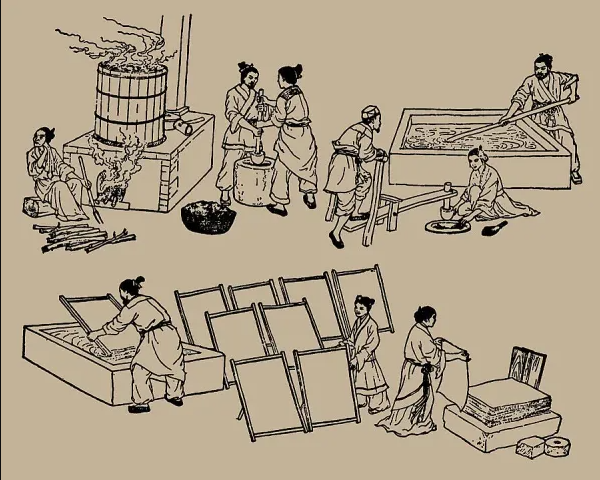
Long before printing presses or notebooks, people in ancient China invented something that changed the world: paper. Around 105 AD, a Han Dynasty court official named Cai Lun created the first known paper using tree bark, old rags, and fishing nets. This invention made writing, learning, and record keeping easier and more affordable than using bamboo or silk.
In this lab, you’ll become an ancient inventor by recycling paper to make your own paper sheets, just like early Chinese innovators. As you work, you’ll explore the science of materials, learn about fiber bonding, and understand why paper was such a revolutionary tool for communication and education.
-
What You Need
About 1 cup of warm water
Used paper scraps (printer paper, notebook paper, magazine paper - not construction paper)
A wire hanger
A piece of nylon stocking (to make a screen)
A blender
A large colander or mixing bowl
Rags or towels
Optional tools: rolling pin, hair dryer, iron and ironing board
-
What You Do
Step 1: Build Your Paper Screen
Bend a wire hanger into a diamond or oval shape.
Stretch a nylon stocking over the hanger to create a flat screen, like a net.
Step 2: Make the Paper Pulp
Tear your used paper into small pieces (about 1 inch or less).
Fill your blender halfway with the paper pieces.
Add about half a cup of warm water at a time and blend. Keep adding water and blending until you get a smooth, soupy pulp with no large chunks.
Optional: Add glitter, colorful paper bits, or flower seeds for decoration. Pulse the blender once or twice to mix.
Step 3: Pour and Shape
Place your colander or mixing bowl in the sink, and set your hanger-screen on top.
Slowly pour the pulp mixture from the blender onto the screen, letting the water drain through into the bowl below.
Use a spatula or spoon to even out the pulp so it’s smooth and spread evenly.
Step 4: Drain and Press
Let your paper drain for at least 30 minutes. The longer it drains, the easier it will be to dry later.
Place several folded towels or rags on a table to create a drying station.
Lay a clean towel over the screen and press gently to flatten the pulp. Smooth out any lumps or holes.
Carefully flip the screen onto the towels so the pulp side faces down.
Place two more towels on top and gently press to squeeze out extra moisture. You can also use a rolling pin to flatten it further.
Step 5: Dry Your Paper
You have a few drying options:
Let it air dry naturally (1–2 days)
Use a hair dryer to speed things up
Carefully iron it between two towels to press and dry at the same time
-
Why was the invention of paper so important for the Han Dynasty?
What kinds of materials did the Chinese use to make their paper?
How did this invention help improve education, government, and daily life?
-
-
Dynasty - A family that rules a country or empire for a long time.
Emperor - The ruler of an empire; the highest leader in ancient China.
Confucianism - A philosophy that teaches respect, kindness, and doing your duty.
Civil Service Exam - A test people took to get government jobs based on skill, not family.
Mandate of Heaven - The belief that rulers were chosen by Heaven and had to rule fairly.
Silk Road - A group of trade routes that connected China to other parts of the world.
Trade - The exchange of goods, services, or ideas between people or countries.
Porcelain - A fine, white ceramic material used to make dishes and vases.
Buddhism - A religion that teaches people how to reach peace through wisdom and kindness.
Invention - A new tool or idea created to solve a problem or make life easier.
Seismograph - A tool used to detect earthquakes, first invented in ancient China.
Irrigation - A way of bringing water to crops to help them grow, especially during dry times.
Filial Piety - A Confucian idea that means children should respect and care for their parents.
Hierarchy - A system where people are ranked in levels of importance or power.
Artisan - A skilled worker who makes things by hand, like tools, pottery, or clothes.
Warlord - A military leader who controls part of a country, often during a time of weak government.
Rebellion - When a group of people fights against the government because they are unhappy.
Corruption - Dishonest behavior by leaders who use their power to help themselves.
Collapse - The sudden fall or failure of a system, government, or empire.
Legacy - Something important that is passed down from one generation to another.