

01 - Civilizations
How Geography Ensured Rome’s Success
The success of Ancient Rome wasn’t just the result of strong leaders or powerful armies; it was also deeply shaped by its geography. Rome’s location on the Italian Peninsula gave it major advantages that helped the civilization grow from a small city-state into a mighty empire. Geography influenced how Romans traded, protected their lands, fed their people, and expanded their population. In this lesson we will examine how access to water, good farmland, natural defenses, and trade routes, placed Rome in the perfect position to grow into one of the most powerful civilizations in the ancient world.
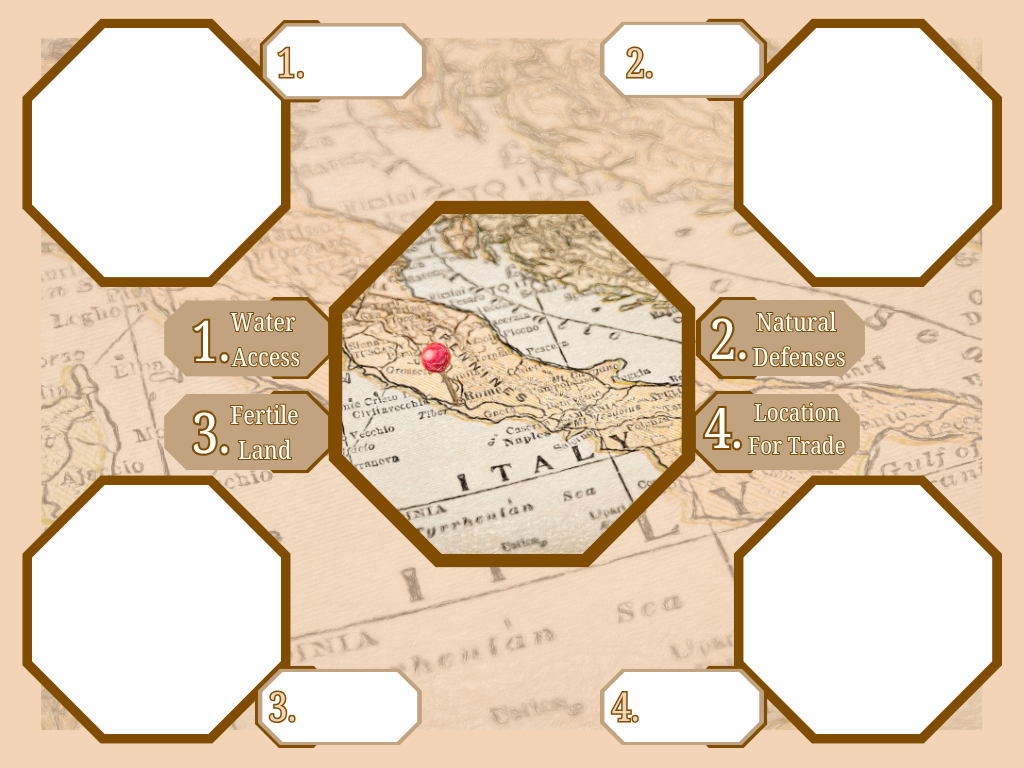
Illustrated Geography Web:
Introduction:
Ancient Rome didn’t just rise to power because of strong leaders or armies; it also had the advantage of being in the right place at the right time. In this activity, you’ll create a visual diagram that shows how Rome’s geography helped it grow into a powerful empire. You’ll explore four key geographic features that supported trade, farming, defense, and population growth.
By combining images and short explanations, you’ll show how natural features like rivers, mountains, and fertile land gave Rome the tools it needed to succeed.
Instructions:
Each key feature of Rome’s Geography which contributed to its growth and success is represented with two blank spaces. The smaller one should be labeled with a specific example that matches that key feature. For example: “1. Water Access” would be labeled with either “Tiber River” or “Mediterranean Sea”.
In the larger of the blank spaces, draw a picture which represents the key feature you have selected.
Complete this process for the remaining blank spaces.
On the back of your paper, write a sentence which explains why this key feature was important to the growth of Rome. For example: “The Alps protected Rome from northern invaders, making it harder for enemies to attack.”
-
-
Republic: A type of government where people elect leaders to make decisions for them.
Empire: A large group of lands ruled by one leader or government.
Senate: A group of powerful leaders in Ancient Rome who helped make laws and decisions.
Patrician: A wealthy and powerful person from Rome's upper class.
Plebeian: A regular Roman citizen, like a farmer, soldier, or merchant, from the lower class.
Tribune: An elected Roman official who helped protect the rights of plebeians.
Consul: One of two top leaders in the Roman Republic who were elected to run the government and army.
Twelve Tables: The first written laws of Rome that told citizens what was legal and what wasn’t.
Pax Romana: A long time of peace and growth in Rome that lasted about 200 years.
Dictator: A leader with complete control, usually for a short time, often during emergencies.
Aqueduct: A system built by Romans to carry fresh water from faraway places into cities.
Architecture: The design and construction of buildings.
Engineering: The use of science and design to build things like roads, bridges, and buildings.
Colosseum: A huge arena in Rome used for public shows and games.
Latin: The language spoken in Ancient Rome, which shaped many modern languages.
Romance Languages: Languages like Spanish, French, and Italian that come from Latin.
Mare Nostrum: A Latin term meaning “Our Sea,” used by Romans to describe the Mediterranean Sea.
Civil War: A war between groups within the same country.
Legacy: Something important or valuable passed down from the past.
Civic Duty: The idea that people should take part in their government and help their community.