

01 - Civilizations
The Roots of Modern Government
The Roman Republic was one of the first governments to use elected officials and a system of checks and balances to organize power. Today, the United States uses many of the same ideas in its democratic system. But while there are some clear similarities, there are also important differences; especially when it comes to who had the right to vote, how leaders were chosen, and the balance of power between classes.
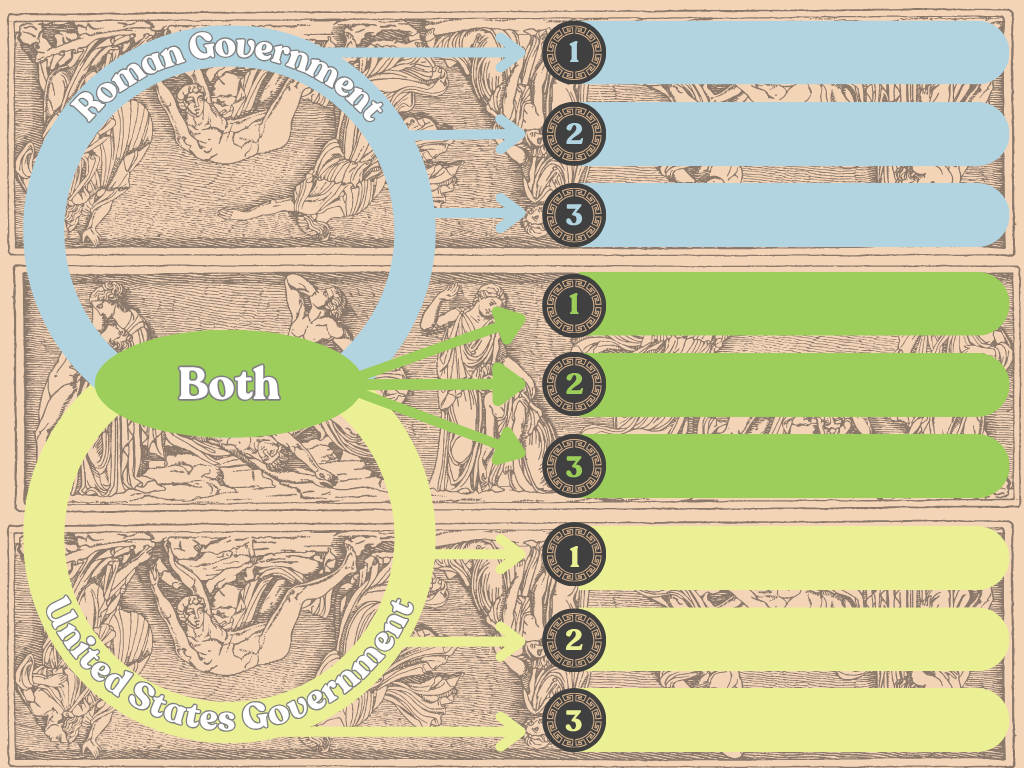
Throughout this lesson, you will see comparisons between the government of Ancient Rome to that of the modern United States. By using a Venn diagram and writing a short paragraph, you will explore how both systems shared common ideas like representation, term limits, and veto powers. You will also note key differences, such as who had access to political power and how long officials served.
Roman Republic vs. U.S. Government
Use your notes or the reading passage to fill out a Venn diagram:
Blue: Roman Republic
Yellow: U.S. Government
Green: Similarities between both
Include at least:
Roles of leaders (Consuls vs. President)
Legislative groups (Senate, Assemblies vs. Senate, House)
Term limits
Voting rights and citizenship
Class differences in participation
Write a Compare and Contrast Paragraph
After completing the diagram, use your ideas to write a 5-6 sentence paragraph that explains:
One major similarity
One or two differences
Why it’s important to study both
-
-
Republic: A type of government where people elect leaders to make decisions for them.
Empire: A large group of lands ruled by one leader or government.
Senate: A group of powerful leaders in Ancient Rome who helped make laws and decisions.
Patrician: A wealthy and powerful person from Rome's upper class.
Plebeian: A regular Roman citizen, like a farmer, soldier, or merchant, from the lower class.
Tribune: An elected Roman official who helped protect the rights of plebeians.
Consul: One of two top leaders in the Roman Republic who were elected to run the government and army.
Twelve Tables: The first written laws of Rome that told citizens what was legal and what wasn’t.
Pax Romana: A long time of peace and growth in Rome that lasted about 200 years.
Dictator: A leader with complete control, usually for a short time, often during emergencies.
Aqueduct: A system built by Romans to carry fresh water from faraway places into cities.
Architecture: The design and construction of buildings.
Engineering: The use of science and design to build things like roads, bridges, and buildings.
Colosseum: A huge arena in Rome used for public shows and games.
Latin: The language spoken in Ancient Rome, which shaped many modern languages.
Romance Languages: Languages like Spanish, French, and Italian that come from Latin.
Mare Nostrum: A Latin term meaning “Our Sea,” used by Romans to describe the Mediterranean Sea.
Civil War: A war between groups within the same country.
Legacy: Something important or valuable passed down from the past.
Civic Duty: The idea that people should take part in their government and help their community.