

01 - Civilizations
Comparing Athens and Sparta
In the ancient world, no two city-states were more famous, or more different, than Athens and Sparta. Though they shared a common language, gods, and identity as Greeks, the values and priorities of these two powerful city-states could not have been more opposite.
Athens, located near the sea, grew into a vibrant center of trade, democracy, education, and the arts. Its people believed in public debate, creativity, and civic participation. Meanwhile, inland Sparta developed into a disciplined, landlocked military society that prized strength, obedience, and simplicity above all else. Spartan boys began military training at the age of seven, and even Spartan women had more freedom than those in other Greek cities.
In this lesson, you’ll explore the key differences between Athens and Sparta: how they were governed, how they educated their citizens, how they fought wars, and how their people lived each day. By comparing these two city-states, you'll see how geography, values, and leadership created very different visions of what it meant to be part of a civilization.
As you build your knowledge, think like a historian: What does each city-state reveal about Greek culture? And which place might you have preferred to live in?
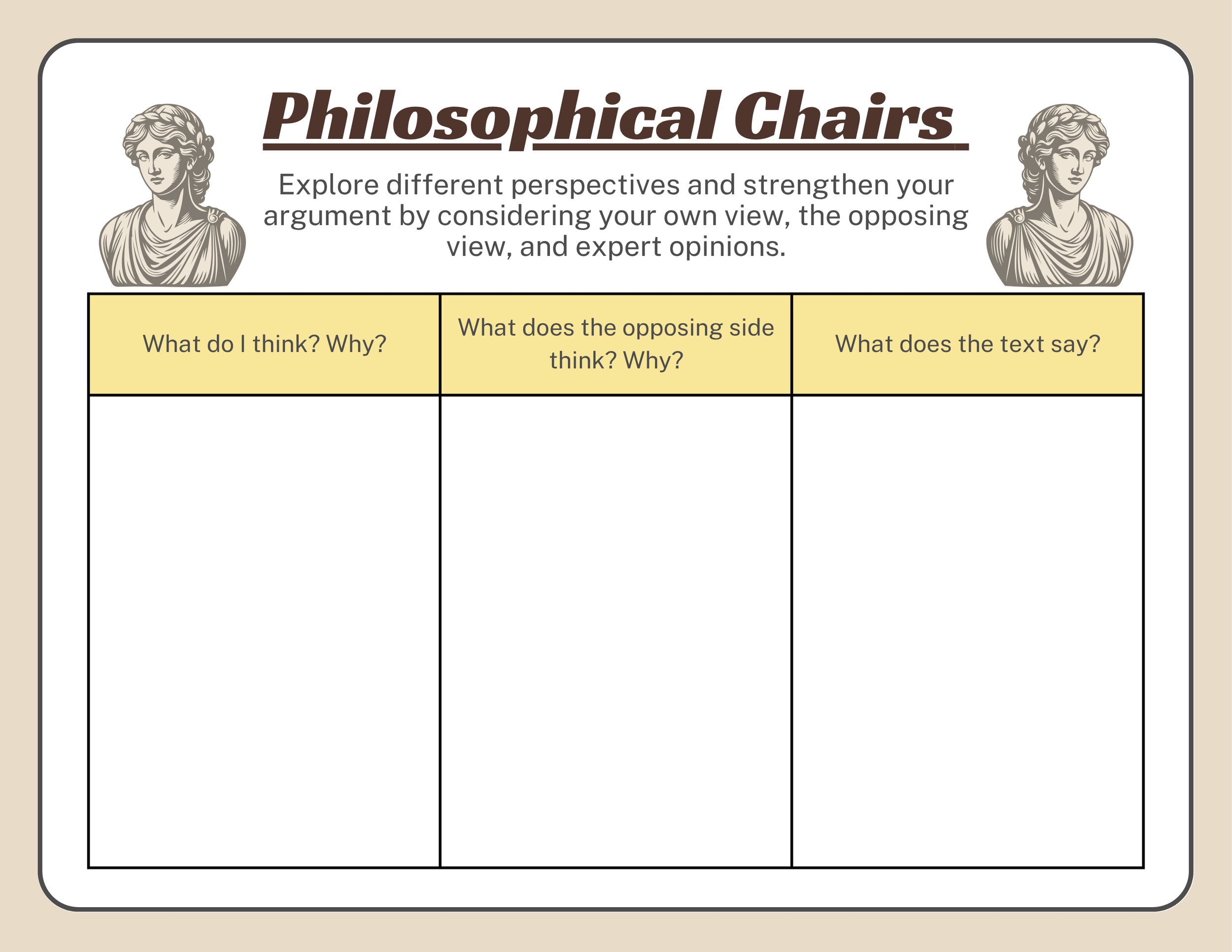
Philosophical Chairs Introduction: Athens vs. Sparta
Now that you've explored the unique strengths and values of Athens and Sparta, it’s time to step into the minds of ancient citizens, and each other! In today’s activity, you’ll participate in a Philosophical Chairs discussion, an AVID strategy that helps us practice speaking, listening, and thinking critically through structured academic dialogue.
You’ve learned that Athens valued democracy, education, and the arts, while Sparta focused on military strength, discipline, and order. Both city-states believed they had the best way of life but which one do you believe was better?
We’ll explore this question together:
“Which city-state had the better way of life: Athens or Sparta?”
You’ll choose a side based on your current opinion: (Athens) or (Sparta) and join others who share your view. As we begin the conversation, remember to support your ideas with evidence from our lesson and speak respectfully using sentence stems like:
“I believe ___________ because…”
“I’d like to respond to that idea by saying…”
“My evidence shows…”
If someone makes a strong argument that changes your mind, you’re encouraged to switch sides, because great thinkers always stay open to new ideas.
This isn’t about winning a debate. It’s about learning to communicate clearly, listen closely, and back up your thoughts with evidence; just like the citizens of Athens might have done in the Assembly, or the warriors of Sparta in a strategy meeting.
-
-
City-State (Polis): A city and the land around it that acted like its own country in Ancient Greece.
Democracy: A type of government where people vote to make decisions.
Oligarchy: A government ruled by a small group of powerful people.
Direct Democracy: A system where citizens vote on laws themselves instead of choosing leaders to vote for them.
Citizen: A person who belongs to a city or country and has rights and responsibilities.
Agora: A public marketplace in Greek city-states where people shopped and gathered for discussion.
Pnyx: A hill in Athens where citizens met to vote and speak in assemblies.
Assembly (Ekklesia): The main group of citizens in Athens that voted on laws and decisions.
Council of 500 (Boule): A group in Athens that planned government business and helped run the city.
Court (Dikasteria): A group of citizens in Athens who served as jurors to decide legal cases.
Pericles:; A leader of Athens who helped develop democracy and encouraged art and education.
Philosopher: A person who asks big questions about life, knowledge, and right and wrong.
Socrates: A famous Greek philosopher who taught by asking questions.
Plato: A student of Socrates who started a school called the Academy.
Aristotle: A Greek thinker who wrote about science, logic, and government; taught Alexander the Great.
Hellenistic: A time when Greek culture mixed with other cultures after Alexander the Great’s conquests.
Olympic Games: Athletic contests started in Ancient Greece to honor the god Zeus.
Columns (Doric, Ionic, Corinthian): Types of tall stone pillars used in Greek buildings.
Drama: Plays written and performed in Greece, including tragedies and comedies.
Legacy: Something handed down from the past, like ideas, inventions, or traditions.