

01 - Civilizations
Christianity in the Roman Empire
In this lesson, we explore how a new faith, Christianity, began to spread during the time of the powerful Roman Empire. It started in a small province called Judea, but within a few centuries, it would grow into one of the most important religions in the world. You’ll learn about the life and teachings of Jesus of Nazareth, how his followers shared his message, and the role of early leaders like Paul the Apostle.
As you read, look for answers to these key questions:
Who was Jesus, and what did he teach?
Why did the Roman government feel threatened by Christianity?
How did early Christians practice their faith even when it was dangerous?
By the end of this lesson, you’ll understand how a group of people who once met in secret eventually helped change the culture and beliefs of the entire Roman world.
Christianity in the Roman Empire: Comprehension Questions
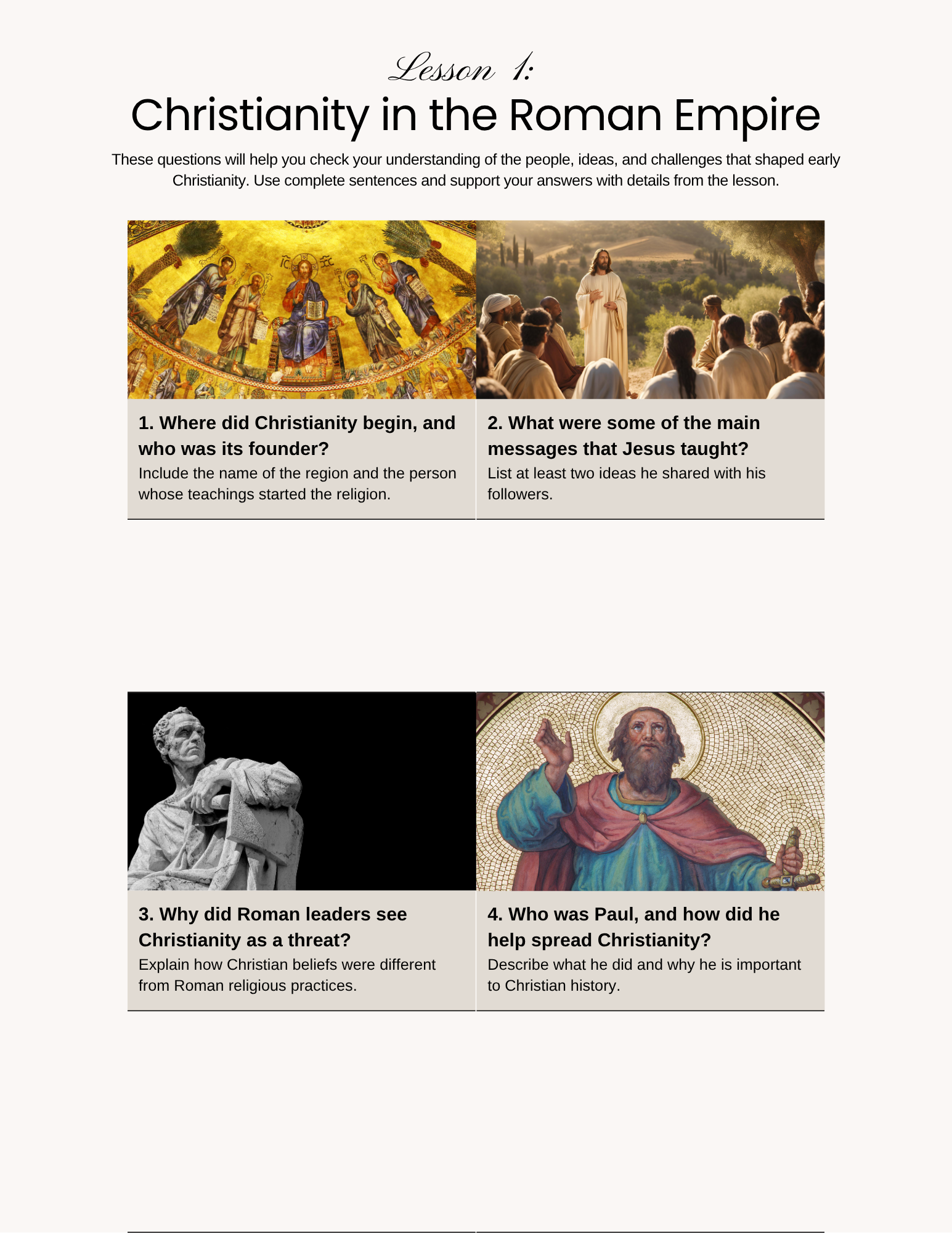
As you read about the rise of Christianity in the Roman Empire, think about how a small group of believers managed to spread their message across one of the world’s largest empires. These questions will help you check your understanding of the people, ideas, and challenges that shaped early Christianity. Use complete sentences and support your answers with details from the lesson.
-
-
Christianity: A religion based on the teachings of Jesus of Nazareth.
Roman Empire: A large ancient empire that ruled much of Europe, North Africa, and the Middle East.
Jesus of Nazareth: The founder of Christianity, believed by Christians to be the Son of God.
Messiah: A savior or chosen one believed to bring peace and justice.
Paul the Apostle: A Christian leader who helped spread Christianity through letters and travel.
Persecution: Being treated badly or punished because of your beliefs.
Catacombs: Underground places where early Christians worshipped and buried their dead.
Constantine: A Roman emperor who made Christianity legal and helped it grow.
Edict of Milan: A law passed in 313 AD that allowed Christians to practice their religion freely.
Conversion: Changing from one religion or belief system to another.
Bishop: A high-ranking Christian leader in charge of churches in a region.
Byzantine Empire: The eastern part of the Roman Empire that lasted after the west fell.
Constantinople: The capital city of the Byzantine Empire, now called Istanbul.
Justinian: A Byzantine emperor known for organizing laws and building churches.
Justinian’s Code: A collection of Roman laws organized by Emperor Justinian.
Hagia Sophia: A famous church in Constantinople built under Justinian’s rule.
Mosaic: A picture made from small pieces of colored stone or glass.
Inflation: When prices go up and money loses value, making it harder to buy things.
Mercenary: A soldier who is paid to fight but may not be loyal to the country.
Barbarian: A name Romans gave to people from outside the empire, often invaders like the Visigoths or Huns.