

01 - Civilizations
Major Religions and Their Foundations
Throughout history, religion has helped people answer life’s biggest questions: about existence, morality, and the afterlife. As civilizations developed, so did great belief systems that shaped their laws, values, and daily lives. This lesson introduces seven of the world’s major religions: Judaism, Hinduism, Buddhism, Confucianism, Daoism, Christianity, and Islam. It will also show how these different religions began in their own distinct region and time period.
Students will explore how these religions emerged, what they believe, and how their teachings continue to influence the world today. From sacred texts and key figures like Abraham, Buddha, Confucius, and Muhammad, to spiritual practices like prayer, meditation, and acts of service; this lesson highlights how belief systems have not only guided individuals but also helped shape the cultures, governments, and traditions of entire societies.
DBQ Writing Prompt: How Religion Shapes Society
Religions are more than systems of belief; they shape how people live, how societies are organized, and how cultures develop over time. From ideas about justice and morality to education, family roles, and even government, religion has been a powerful force in shaping the structure and values of civilizations. In this writing assignment, you will explore how two of the world’s major religions influenced the societies in which they began. You’ll use evidence from World Builders Issue 06 to support your ideas and demonstrate your understanding of how belief systems can impact laws, traditions, and daily life.
-
Choose Two Religions
Select any two religions discussed in the reading (Judaism, Hinduism, Buddhism, Confucianism, Daoism, Christianity, Islam).Review the Text
Revisit the sections on your chosen religions. Highlight key beliefs, teachings, or practices that had a direct impact on social structures, laws, education, leadership, or daily life in that society.Plan Your Paragraph
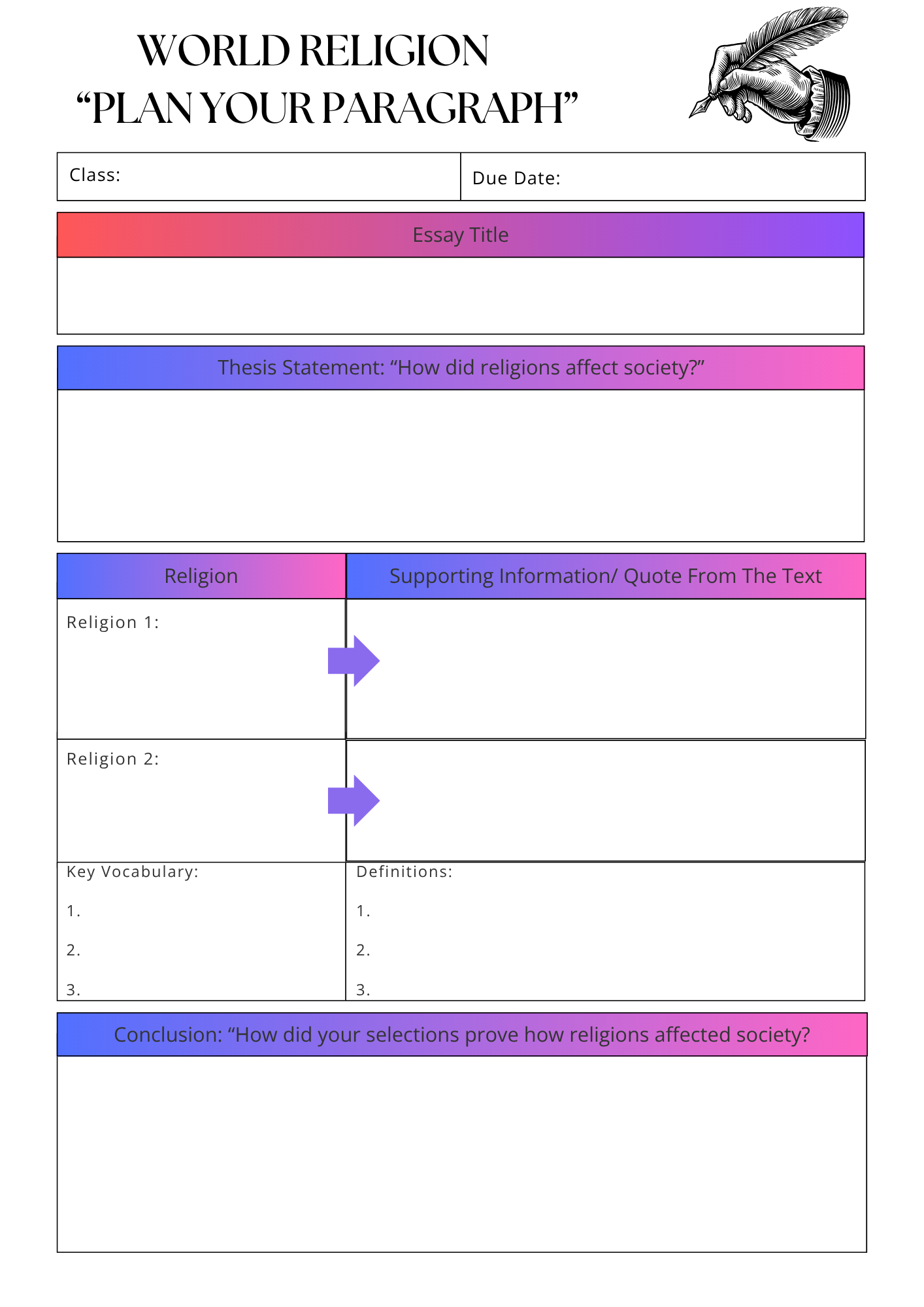
Use the following outline to organize your response:Topic Sentence: Clearly state your argument about how religion shapes society.
Example 1: Name your first religion and describe one belief or practice that influenced its society.
Evidence: Quote or paraphrase from the reading to support your point.
Example 2: Name your second religion and explain a different way it impacted its society.
Evidence: Provide supporting detail from the text.
Closing Sentence: Summarize your main point and reflect on why religion was such a powerful force in early civilizations.
Write in Complete Sentences
Use formal writing conventions. Include transition words like “For example,” “Another influence,” and “This shows that...”Use Key Vocabulary
Be sure to use at least three content-specific terms from the reading, such as: karma, covenant, Torah, monotheism, pilgrimage, enlightenment, Dao, ethics.Revise and Edit
After writing your first draft, check for:Clarity and organization
Use of evidence
Spelling, grammar, and punctuation
-
Clearly explains how two religions shaped society
Uses evidence from the reading to support ideas
Includes historical vocabulary appropriately
Well-organized, complete sentences
Thoughtful reflection on religion’s impact
-
-
Religion : A system of beliefs about the meaning of life, usually involving gods, rituals, and moral rules.
Sacred: Something holy or very special to a religion.
Monotheism: Belief in only one God.
Polytheism: Belief in many gods and goddesses.
Covenant: A sacred agreement or promise, especially between God and people in Judaism.
Prophet: A person who is believed to speak messages from God.
Karma: The idea in Hinduism that your actions affect what happens to you.
Reincarnation: The belief that after you die, your soul is born again in a new body.
Dharma: In Hinduism, the moral duties a person must follow.
Enlightenment: A deep understanding of truth; in Buddhism, the end of suffering and desire.
Meditation: A practice of focusing the mind to reach peace and understanding.
Filial Piety: A Confucian belief in respecting your parents and ancestors.
The Dao (Tao): In Daoism, the natural way the universe works, which people should follow.
Yin and Yang: Daoist idea that opposite forces (like light and dark) are connected and balanced.
The Five Pillars: The five main duties every Muslim is expected to follow in Islam.
Missionary: A person who travels to spread their religion to others.
Pilgrimage: A journey to a sacred place for religious reasons.
Sacred Text: A holy book that teaches the beliefs and rules of a religion.
Monastery: A place where monks or nuns live and practice their religion.
Cultural Diffusion: The spreading of beliefs, ideas, or traditions from one group to another.