

01 - Civilizations
The Influence of Confucianism Within The Han Government
When we study ancient civilizations like the Han Dynasty, it’s important to understand how the government and beliefs helped the empire grow and stay strong. In this lesson, you will learn how Emperor Wu (Han Wudi) made big changes to leadership by using Confucianism and creating a fairer way to choose government workers.
As you read, look for the following key details:
How Emperor Wu (Han Wudi) helped organize and strengthen the Han government
Why Confucianism was used to guide leaders and decision-making
What the civil service exams were and what subjects they included
How people could earn government jobs through hard work and learning, not family status
Why this system helped make the Han government more fair, smart, and respected
By the end of this lesson, you should be able to explain how the Han Dynasty’s government system gave more people a chance to lead, and how Confucian values and civil service exams helped the empire become one of the most successful in ancient China.
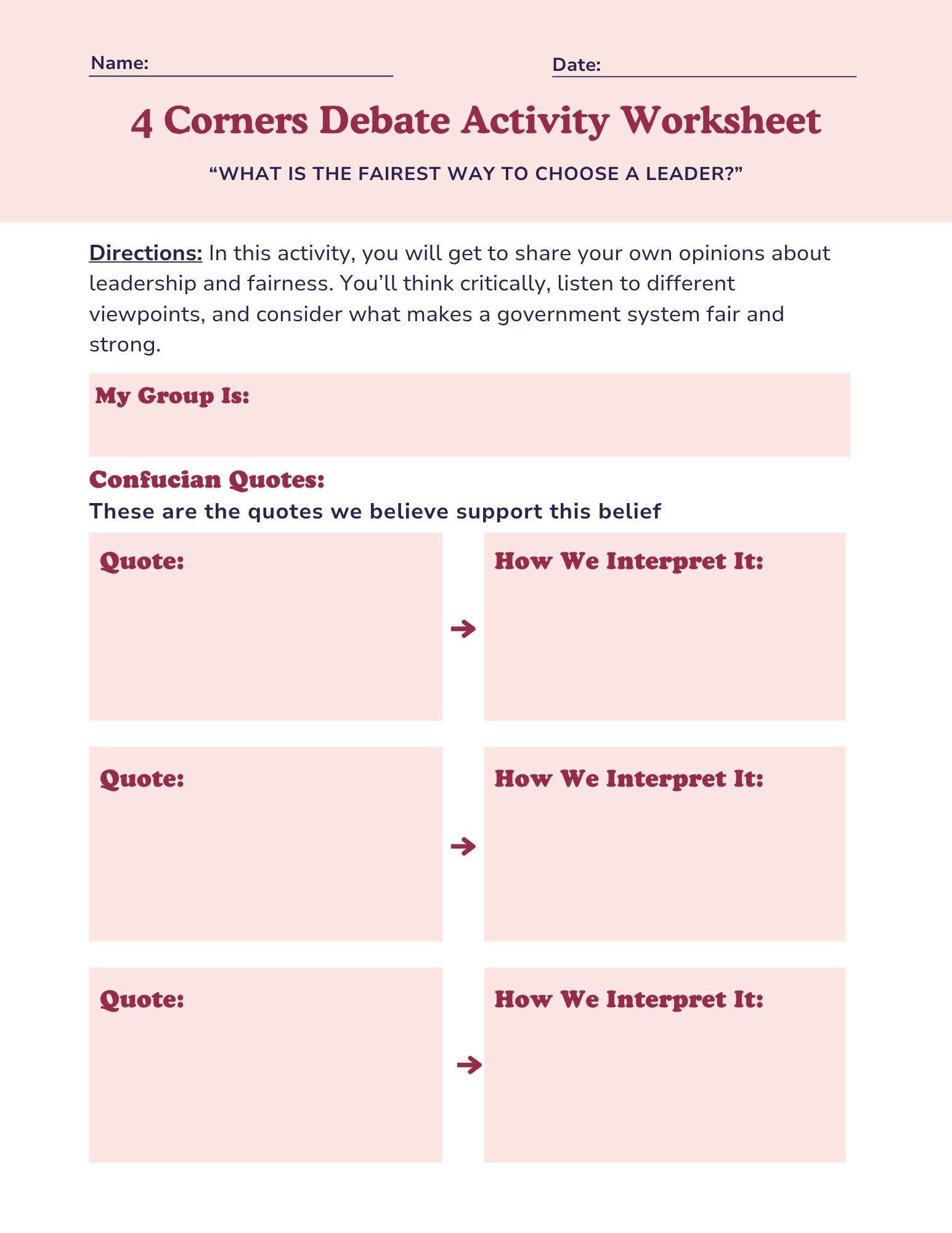
4 Corners Debate: “What is the fairest way to choose a leader?”
During the Han Dynasty, Emperor Wudi introduced a new system for choosing government leaders. Instead of giving jobs to people from wealthy families, he started using civil service exams that tested a person’s knowledge, morals, and understanding of Confucian ideas. This was a major change that helped shape government in China for over 2,000 years and influenced other parts of the world too.
But this raises an important question:
What is the fairest way to choose a leader?
Should leaders be born into power? Chosen for their intelligence? Tested for their ability? Or selected by the people?
In this activity, you’ll explore your own opinion, and Confucius’s ideas, by taking a stand in different corners of the room.
-
Step 1: Think About the Question
Read the question on the board:
What is the fairest way to choose a leader?
Review the four options and read the Confucian quotes at each station. Consider:
What would Confucius support?
What system would make a government fair and strong?
Step 2: Choose a Corner
Silently walk to the corner that represents your opinion. Stand with others who agree with your answer.
Group Discussion
In your group:
Take turns explaining why you chose that answer.
Use the Confucian quotes at your station to support your ideas.
Use sentence stems in your discussion
Corner 1: “Only people born into power should rule”
I believe rulers should be born into power because...
Confucius taught that roles and traditions matter, so...
Rulers raised in power are prepared to lead because...
Corner 2: “The smartest person should rule”
I believe the smartest person should lead because...
A wise leader can avoid mistakes by...
Confucius valued wisdom, so someone smart would...
Corner 3: “A person who passes a fair test should rule”
I think passing a fair test shows who is ready because...
Confucius believed learning and thinking are both important, so...
Tests give everyone a fair chance to show they are capable because...
Corner 4: “The people should vote on who rules”
I believe voting is the fairest system because...
Confucius said the people are the root of the nation, so...
When people choose their leaders, they are more likely to...
Step 3: Spokesperson Shares Out
Each group chooses one spokesperson to explain:
Why your group chose that option
Which Confucian quote supported your reasoning
Step 4: Switching Corners
After hearing all sides, students may switch corners if they’ve changed their minds.
Students who move must explain why:“I moved because I now believe…”
Exit Reflection
Students write a short response answering the following:
“What is the fairest way to choose a leader, and why?”
“How did Confucius’s ideas influence your thinking?”
“Would this system work today?”
-
World Builders: Issue 08
-
Dynasty - A family that rules a country or empire for a long time.
Emperor - The ruler of an empire; the highest leader in ancient China.
Confucianism - A philosophy that teaches respect, kindness, and doing your duty.
Civil Service Exam - A test people took to get government jobs based on skill, not family.
Mandate of Heaven - The belief that rulers were chosen by Heaven and had to rule fairly.
Silk Road - A group of trade routes that connected China to other parts of the world.
Trade - The exchange of goods, services, or ideas between people or countries.
Porcelain - A fine, white ceramic material used to make dishes and vases.
Buddhism - A religion that teaches people how to reach peace through wisdom and kindness.
Invention - A new tool or idea created to solve a problem or make life easier.
Seismograph - A tool used to detect earthquakes, first invented in ancient China.
Irrigation - A way of bringing water to crops to help them grow, especially during dry times.
Filial Piety - A Confucian idea that means children should respect and care for their parents.
Hierarchy - A system where people are ranked in levels of importance or power.
Artisan - A skilled worker who makes things by hand, like tools, pottery, or clothes.
Warlord - A military leader who controls part of a country, often during a time of weak government.
Rebellion - When a group of people fights against the government because they are unhappy.
Corruption - Dishonest behavior by leaders who use their power to help themselves.
Collapse - The sudden fall or failure of a system, government, or empire.
Legacy - Something important that is passed down from one generation to another.