

01 - Civilizations
Silk, Spices, and Secrets: The Path That Connected the World
When we think about ancient trade, we often picture people exchanging gold, silk, or spices. But trade routes like the Silk Road were about much more than just goods: they also connected people, cultures, religions, and even diseases. In this lesson, you’ll learn how the Han Dynasty helped open the world through trade, diplomacy, and cultural exchange by protecting and expanding the Silk Road.
As you read, look for the following key details:
What types of goods were traded along the Silk Road and how they moved across land and sea
Why silk was so valuable and how China protected the secret of how it was made
How the Silk Road helped spread Buddhism and other cultural ideas from India to China
What kinds of music, food, language, and fashion were shared between civilizations
How the movement of people also spread dangerous diseases that hurt empires like Han China and Rome
By the end of this lesson, you should be able to explain how the Silk Road helped the Han Dynasty become more connected with the rest of the world - and how this exchange changed daily life, beliefs, and even the health of ancient people.
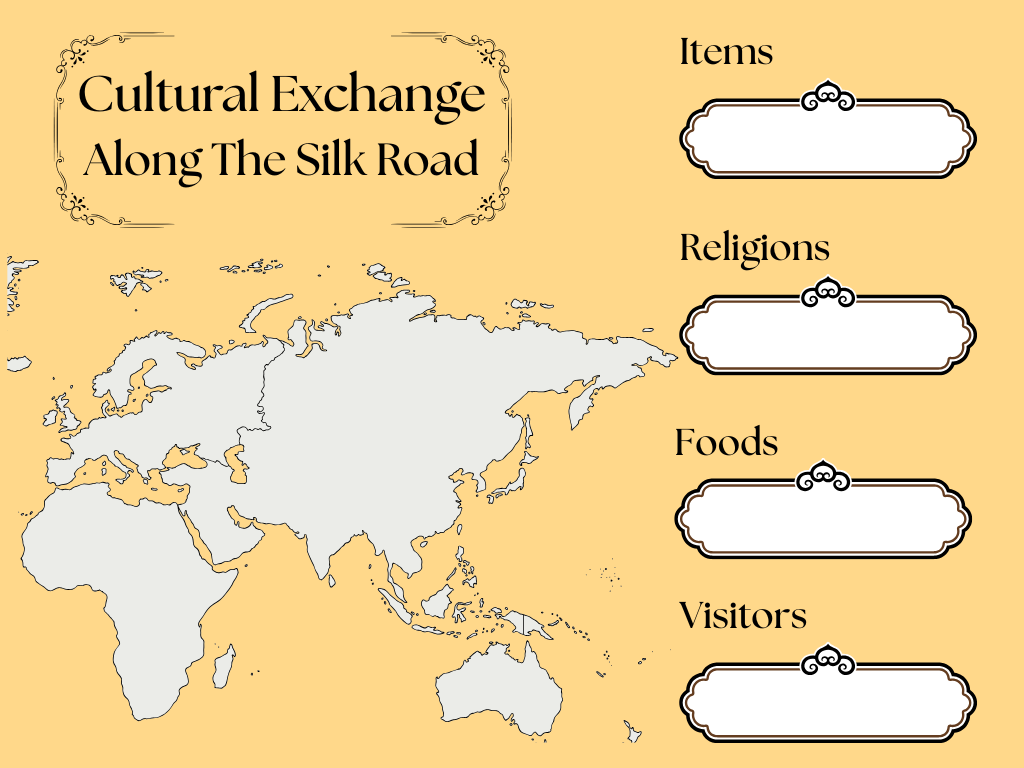
Silk Road Cultural Exchange Poster
Imagine you're living in a bustling city along the Silk Road over 2,000 years ago. Every day, you might hear new languages, see travelers from distant lands, taste exotic spices, and watch merchants trade silks for gold, glass, and horses. Cities along the Silk Road weren’t just marketplaces, they were gateways for sharing cultures, beliefs, and inventions.
During the Han Dynasty, these trade routes helped link China to India, Central Asia, Persia, and even the Roman Empire. As goods moved, so did ideas, like Buddhism, new foods, musical styles, clothing, technologies, and even ways of writing. Each city became a cultural melting pot, shaped by the travelers who passed through and the treasures they brought with them.
In this activity, you and your group will become cultural historians. You'll choose one important city along the Silk Road and create a poster that shows what life might have been like there. Your goal is to show how that city became a hub of trade, religion, art, and daily life by blending local traditions with foreign influences.
-
Instructions:
Form a Group:
Join a group of 2 - 4 students. Each group will focus on one city along the Silk Road such as:Chang’an (China)
Samarkand (Central Asia)
Alexandria (Egypt)
Khotan (Western China)
Baghdad (Persia)
2. Research Your City:
Use class resources (readings, maps, internet-approved sources) to find:What items were traded in or through this city? (Example: silk, glass, spices, paper)
What religions or beliefs were shared or practiced there? (Example: Buddhism)
What foods or recipes might travelers encounter?
What types of people visited or lived there? (Example: traders, monks, artists, soldiers)
3. Design Your Poster:
Your poster should be colorful, neat, and clearly organized. Be sure to include:Symbols or pictures for each category (trade, religion, food, people)
Brief captions explaining each symbol or image
A map marker showing your city’s location on a mini Silk Road map
A title and your group members’ names
4. Share Your Work:
Prepare to present your poster to the class. Explain how your city was a crossroads of culture and what made it unique on the Silk Road.
-
Britannica - Silk Road
Overview of trade routes, key cities, goods, and cultural exchange.UNESCO - Silk Roads Interactive Map
Focuses on how art and goods were exchanged along the Silk Road.History.com - Goods Traded on the Silk Road
Describes key goods like silk, spices, and horses.Alexandria
A major Mediterranean port and cultural center connected to overland and maritime Silk Road routes.Chang-an
Capital of the Han Dynasty and the eastern starting point of the Silk Road.Samarkand
Explore this key Silk Road city in Central Asia known for its cultural mix and architecture.
-
-
Dynasty - A family that rules a country or empire for a long time.
Emperor - The ruler of an empire; the highest leader in ancient China.
Confucianism - A philosophy that teaches respect, kindness, and doing your duty.
Civil Service Exam - A test people took to get government jobs based on skill, not family.
Mandate of Heaven - The belief that rulers were chosen by Heaven and had to rule fairly.
Silk Road - A group of trade routes that connected China to other parts of the world.
Trade - The exchange of goods, services, or ideas between people or countries.
Porcelain - A fine, white ceramic material used to make dishes and vases.
Buddhism - A religion that teaches people how to reach peace through wisdom and kindness.
Invention - A new tool or idea created to solve a problem or make life easier.
Seismograph - A tool used to detect earthquakes, first invented in ancient China.
Irrigation - A way of bringing water to crops to help them grow, especially during dry times.
Filial Piety - A Confucian idea that means children should respect and care for their parents.
Hierarchy - A system where people are ranked in levels of importance or power.
Artisan - A skilled worker who makes things by hand, like tools, pottery, or clothes.
Warlord - A military leader who controls part of a country, often during a time of weak government.
Rebellion - When a group of people fights against the government because they are unhappy.
Corruption - Dishonest behavior by leaders who use their power to help themselves.
Collapse - The sudden fall or failure of a system, government, or empire.
Legacy - Something important that is passed down from one generation to another.