

01 - Civilizations
Groundbreaking Government
Over 2,500 years ago, the people of Athens made a bold and groundbreaking decision: they created a new kind of government where citizens, not kings or nobles, had the power to vote and shape their city’s future. This system, known as direct democracy, gave eligible Athenians the right to speak and vote on laws in the Assembly. During the Age of Pericles, Athens expanded these democratic practices, encouraging more citizens to participate in civic life, attend debates, serve on juries, and hold public office. Even though only free adult males born in Athens could vote, this early form of democracy laid the foundation for the modern governments we have today.
In this lesson, you will explore how Athenian democracy worked, who got to participate, and why it was so important to the development of future civilizations. You’ll learn about the Assembly, the Council of 500, and how leaders like Pericles helped shape the idea of citizenship and public service. As you read, discuss, and write, think about the legacy Athens left behind: What does it mean to be a citizen? Who should have a voice in government? And how do the ideals of ancient Athens still influence us today?
“How Athenian Democracy Worked”
Athenian democracy was one of the first systems in history where everyday citizens had the power to vote on laws and participate in government decisions. But how did it work? In this activity, you’ll break down the main parts of Athenian democracy and understand how each one contributed to the functioning of the city-state.
Instructions:
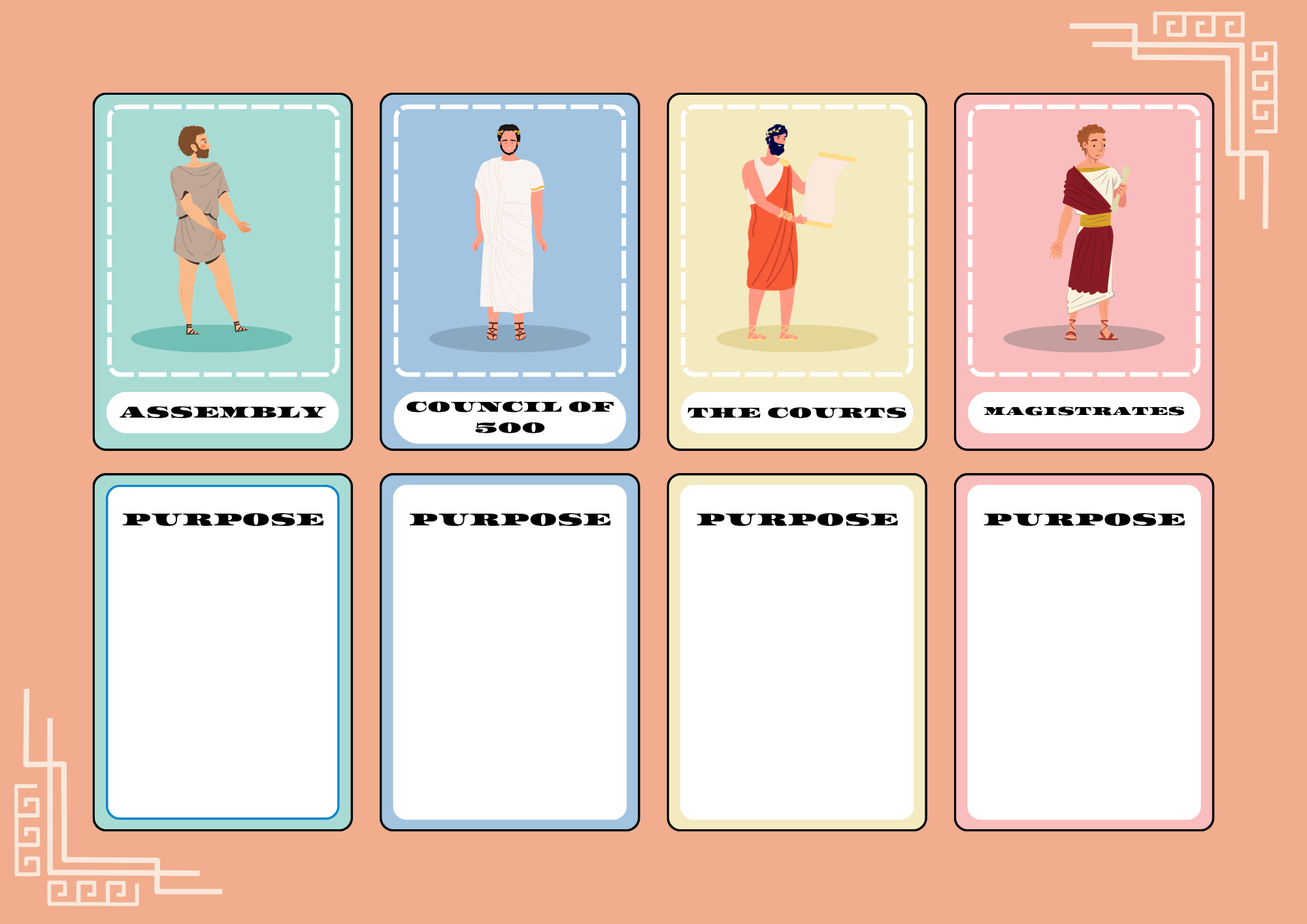
Complete the graphic organizer by labeling and describing the four main parts of Athenian democracy:
The Assembly
The Council of 500
The Courts
Magistrates
For each part, write:
What did this group do?
Why it was important to the democratic system?
Use your notes and the text to support your answers.
-
-
City-State (Polis): A city and the land around it that acted like its own country in Ancient Greece.
Democracy: A type of government where people vote to make decisions.
Oligarchy: A government ruled by a small group of powerful people.
Direct Democracy: A system where citizens vote on laws themselves instead of choosing leaders to vote for them.
Citizen: A person who belongs to a city or country and has rights and responsibilities.
Agora: A public marketplace in Greek city-states where people shopped and gathered for discussion.
Pnyx: A hill in Athens where citizens met to vote and speak in assemblies.
Assembly (Ekklesia): The main group of citizens in Athens that voted on laws and decisions.
Council of 500 (Boule): A group in Athens that planned government business and helped run the city.
Court (Dikasteria): A group of citizens in Athens who served as jurors to decide legal cases.
Pericles:; A leader of Athens who helped develop democracy and encouraged art and education.
Philosopher: A person who asks big questions about life, knowledge, and right and wrong.
Socrates: A famous Greek philosopher who taught by asking questions.
Plato: A student of Socrates who started a school called the Academy.
Aristotle: A Greek thinker who wrote about science, logic, and government; taught Alexander the Great.
Hellenistic: A time when Greek culture mixed with other cultures after Alexander the Great’s conquests.
Olympic Games: Athletic contests started in Ancient Greece to honor the god Zeus.
Columns (Doric, Ionic, Corinthian): Types of tall stone pillars used in Greek buildings.
Drama: Plays written and performed in Greece, including tragedies and comedies.
Legacy: Something handed down from the past, like ideas, inventions, or traditions.