Early Civilizations
Every lesson in this unit has its own card. Select a card to flip it, read what the lesson is about, then open the lesson when you are ready.

Lesson Card Summaries
Hover over a card to light it up. Select it to flip the card for the lesson summary.
 LESSON 1.1
The Anatomy of a Civilization
Select for SummaryThe Anatomy of a Civilization
Unit Launch, Foundations of World-BuildingEvery world you will ever build, real or invented, rests on the same four pillars. Today we travel to the oldest cities on record to find them, then use what we find to test whether a world can stand.
Header landmark: Ziggurat of Ur — Tell el-Muqayyar, Iraq (c. 2100 BCE)
 LESSON 1.2
Mesopotamia II: Cities, Kings, and Empires
Select for SummaryMesopotamia II: Cities, Kings, and Empires
The Rise and Fall of Babylon and AssyriaSumer's city-states were only the beginning. Today we follow Mesopotamia from Hammurabi's law code through the Assyrian war machine to the empire's final collapse, tracking what stayed the same and what changed.
Header landmark: Ishtar Gate of Babylon (reconstruction, Pergamon Museum)
 LESSON 1.3
Ancient Egypt I: The Gift of the Nile
Select for SummaryAncient Egypt I: The Gift of the Nile
Geography, Agriculture, and the Old KingdomNo river shaped a civilization more predictably than the Nile. Today we find out why Egypt's geography produced one of history's most stable kingdoms, not its most chaotic one.
Header landmark: Great Pyramids of Giza and the Great Sphinx
 LESSON 1.4
Ancient Egypt II: Pharaohs, Power, and the Afterlife
Select for SummaryAncient Egypt II: Pharaohs, Power, and the Afterlife
Government, Religion, and the New KingdomA pharaoh was not just a king. Today we look at how political power and religious belief fused into one office, and how that office built an empire.
Header landmark: Great Hypostyle Hall, Temple of Karnak — Luxor
 LESSON 1.5
Kush and Nubia: Africa's River Valley Civilization
Select for SummaryKush and Nubia: Africa's River Valley Civilization
Trade, Conquest, and Iron South of EgyptEgypt was not the only river valley civilization in Africa. Today we travel south to Kush, a kingdom that traded with Egypt, was conquered by Egypt, and eventually conquered Egypt right back.
Header landmark: Pyramids of Meroë — Sudan
 LESSON 1.6
The Phoenicians: Trade, the Alphabet, and a Connected Mediterranean
Select for SummaryThe Phoenicians: Trade, the Alphabet, and a Connected Mediterranean
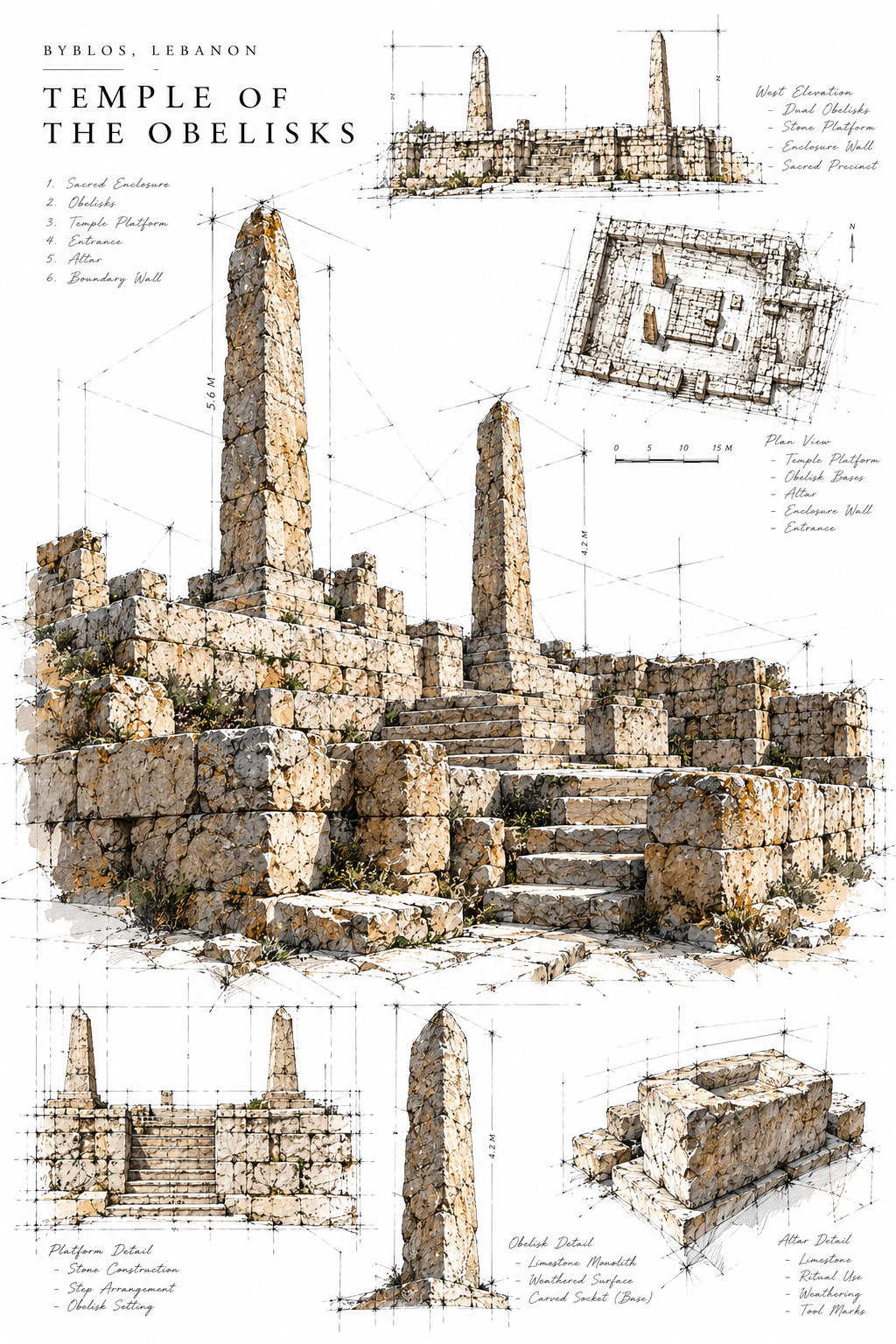
A Civilization Built on the Sea, Not the LandNot every civilization we study built an empire. The Phoenicians built something arguably more lasting: the alphabet you are reading right now.
Header landmark: Ancient harbor and Temple of the Obelisks — Byblos, Lebanon
 LESSON 1.7
The Indus Valley Civilization: Cities Without Kings?
Select for SummaryThe Indus Valley Civilization: Cities Without Kings?
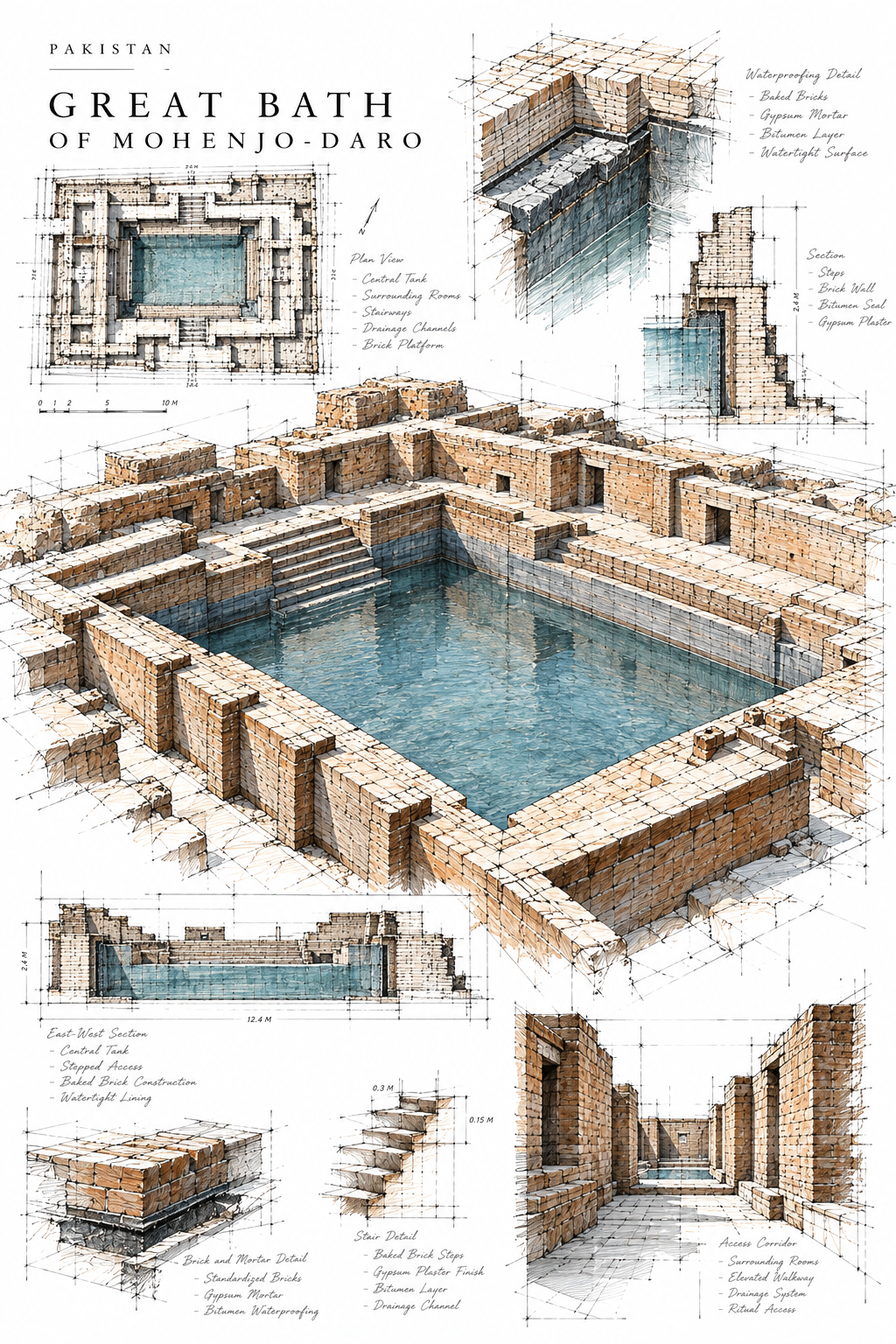
Urban Planning and an Unsolved MysteryThe Indus Valley built some of the best-engineered cities of the ancient world, and left behind almost no record of who was in charge. Today we work like historians facing real uncertainty.
Header landmark: Great Bath of Mohenjo-daro — Pakistan
 LESSON 1.8
The Vedic Period: Migration, Belief, and a New Social Order
Select for SummaryThe Vedic Period: Migration, Belief, and a New Social Order
India After the Indus CitiesWhen the Indus Valley's great cities declined, a new people, a new religion, and a new social order took root in their place. Today we track what changed in India, and what patterns endured.
Header landmark: Ghats of Varanasi on the Ganges at dawn
 LESSON 1.9
The Huang He Valley: China's Cradle of Civilization
Select for SummaryThe Huang He Valley: China's Cradle of Civilization
The Yellow River and the Shang DynastyEvery river valley civilization we've studied has been shaped by its river, for better and worse. Today we meet the Huang He, a river so unpredictable its own people nicknamed it 'China's Sorrow.'
Header landmark: Yinxu, the Shang capital ruins — Anyang, China
 LESSON 1.10
The Zhou Dynasty: The Mandate of Heaven
Select for SummaryThe Zhou Dynasty: The Mandate of Heaven
A New Justification for PowerWhen the Zhou overthrew the Shang, they needed a reason the rest of China would accept. The idea they invented outlived the Zhou Dynasty itself by thousands of years.
Header landmark: Zhouyuan ancestral-temple ruins — Qishan, Shaanxi
 LESSON 1.11
Comparing the River Valley Civilizations
Select for SummaryComparing the River Valley Civilizations
Synthesis, Six Civilizations, One FrameworkYou've now studied six river valley civilizations across three continents. Today we put them side by side and answer the unit's real question: what do civilizations actually have in common?
Header landmark: Four-panel strip: Ziggurat of Ur · Giza · Mohenjo-daro · Yinxu
 LESSON 1.12
Unit 1 Review and Test Preparation
Select for SummaryUnit 1 Review and Test Preparation
Evidence, Perspective, and the Unit 1 TestTwelve lessons, six civilizations, one test. Today we don't learn anything new. We prove what we know, and we practice arguing it with evidence.
Header landmark: Code of Hammurabi stele in the Louvre gallery