World Builders
Academy
World Builders Academy turns Social Studies into a study of how people design worlds, shape systems, and inspire ideas for those who come next.
noun: A person who puts parts or materials together over time to create something. The architect of tomorrow’s design.
Build history. Design the future.
World Builders is more than a social studies course. It is a living atlas of imagination and inquiry, where students become historians, designers, and architects of civilization. Across eight units and 153 lessons, each lesson unfolds as a crafted narrative experience, blending storytelling, primary sources, and project-based exploration into an interactive journey from the first river valley cities to the fight for human rights today.
Learners don’t just memorize facts; they build worlds by analyzing how geography shapes culture, how belief shapes art, and how innovation reshapes humanity.
Through illustrated readings, collaborative simulations, and interdisciplinary challenges, students practice the art of synthesis: connecting history, science, language, and design to see civilization as a dynamic system rather than a static timeline.
Unlike traditional history courses that ask learners to recall what was, World Builders invites them to create what could be. It reframes the study of civilization as a place where critical thinking meets creative production, and every project becomes a living artifact of understanding.
Each lesson is infused with the Aletheian Design Theory of Learning, merging the visual and narrative power of modern media with rigorous academic inquiry. The result is a curriculum that feels more like entering a studio than a classroom: a place where learning is aesthetic, inquiry is collaborative, and history becomes a canvas for the imagination.
Eight units. One connected story.
Each unit has its own launch page with a card for every lesson. Open a unit to preview its lessons, or start with its first lesson.

Early Civilizations
Mesopotamia, Egypt, Kush, Phoenicia, the Indus Valley and the Huang He. How rivers, farming, belief, writing and law built the first complex societies.

Classical Civilizations
Han China, Mauryan and Gupta India, Greece and Rome, and the rise of Judaism, Christianity and Islam. How classical societies organized power and passed down ideas.

Early Global Interactions
The Byzantine Empire, the spread of Islam, the Crusades, Ghana, Mali and Songhai, and the Mongols. How trade, faith and conquest connected the world.

Expansion of Empires
The Age of Exploration, the Aztec, Inca and Maya, the Columbian Exchange, mercantilism and the transatlantic slave trade.
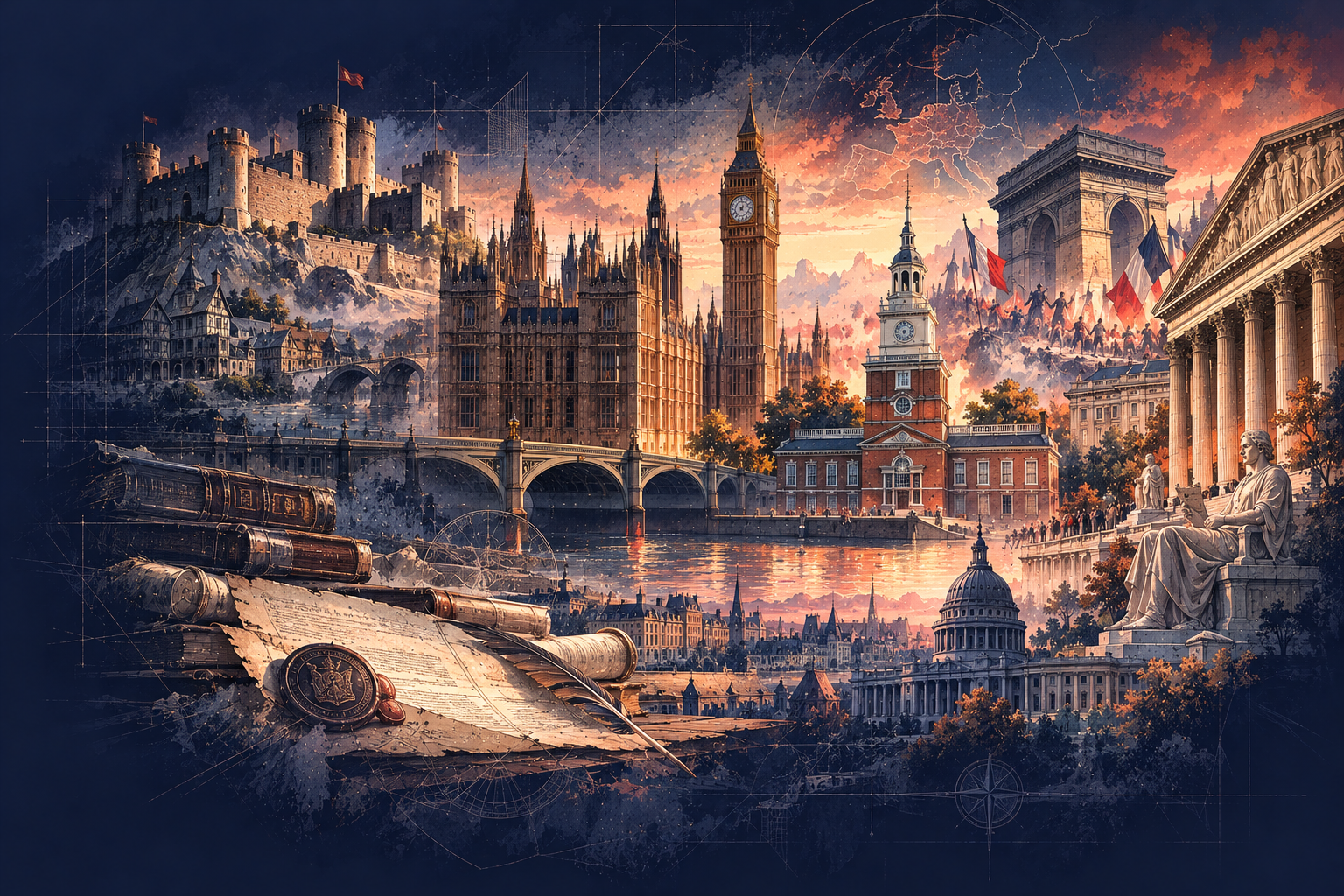
Political Systems and Individual Rights
Feudal Japan and Europe, the Magna Carta, absolute monarchy, the Renaissance and Reformation, the Enlightenment, and the French and Haitian Revolutions.

The Industrial Revolution
From farms to factories: machines, railroads, cities, child labor and reform, then oil, sustainability and the Information Age.
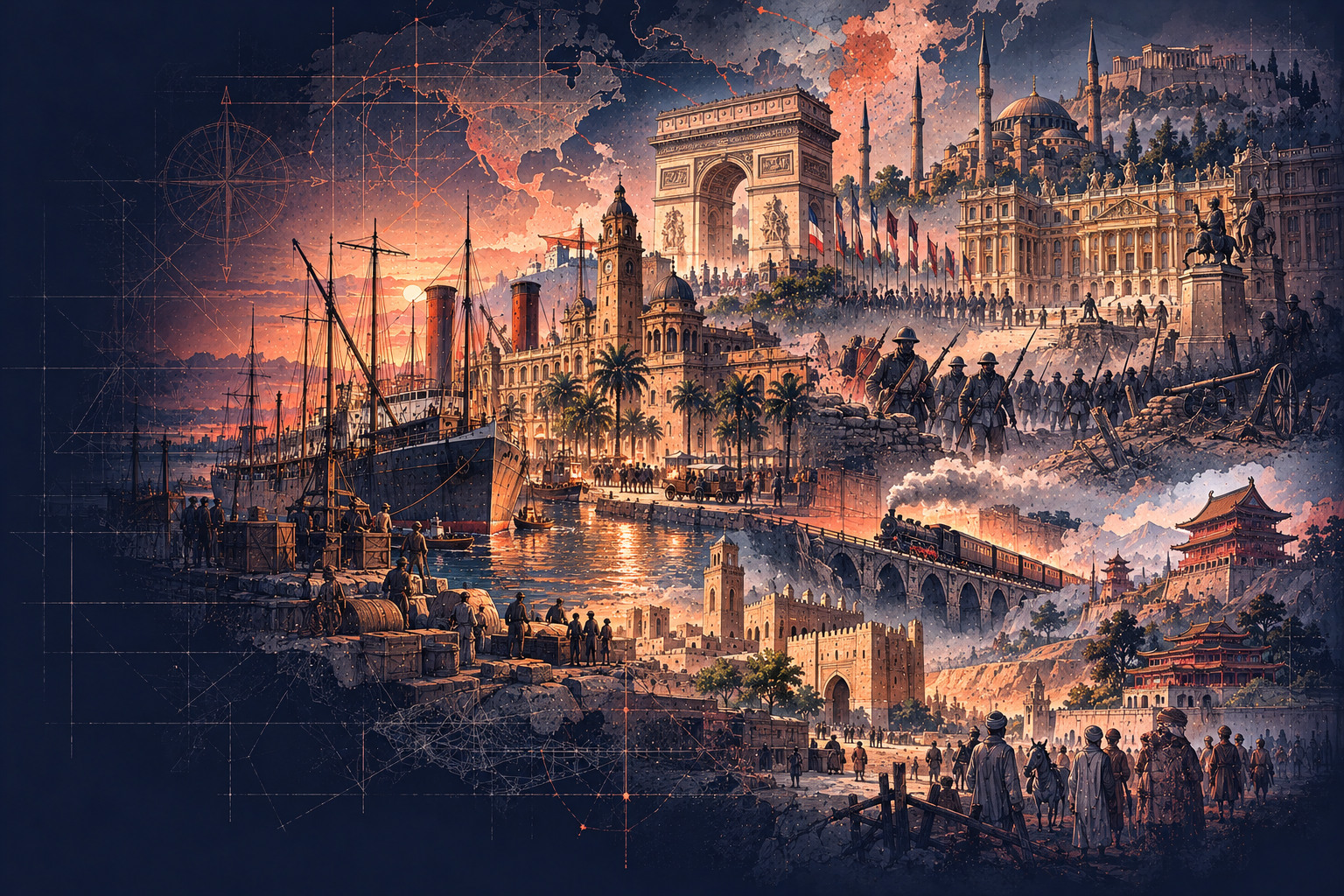
The Age of Empires and Renewed Nationalism
Imperialism in Africa and Asia, World War I, the Great Depression, fascism, World War II and the Holocaust, and the Cold War.

The Modern Era and Human Rights
The Universal Declaration of Human Rights, decolonization, civil rights movements, the end of apartheid, and voices for rights today.
noun: The process of studying how geography, culture, power, belief, technology, and human decisions combine to shape a civilization.
Every civilization begins somewhere. Learners investigate rivers, mountains, deserts, coastlines, climate, resources, and location to understand why settlements form, how societies adapt, and how geography creates both opportunity and constraint.
Maps, artifacts, primary sources, images, data, and secondary accounts become evidence. Students learn to ask who created a source, what it reveals, what it leaves uncertain, and how multiple pieces of evidence can support a historical explanation.
Learners compare systems across place and time. Greek democracy and the Roman Republic, Mali and Songhai, European knights and Japanese samurai, and the four river valley civilizations become opportunities to identify patterns, differences, continuities, and human responses to similar problems.
Interactive maps, narrative missions, games, design challenges, source investigations, trading-card systems, simulations, and visual artifacts transform content into something learners can navigate, question, test, and remember.
Each unit contributes to a larger historical arc. Students trace how political structures, trade networks, cultural exchange, belief systems, scientific ideas, conflict, and innovation accumulate across time and help explain the world they inhabit today.
World Builders Academy
Reimagining Worlds For The Modern Visionary.