 Studio Aletheia · World Builders Academy
6.1.CCSC 6th Grade World Civilizations
The Road That Connected Everyone
Lesson 2.17 · The Silk Road and Classical Trade Networks
No classical civilization in this unit grew in isolation. A vast web of trade routes connected China, India, Persia, and Rome long before any of their citizens ever met face to face. Today you trace what traveled those routes besides silk.
Learning Targets and Success Criteria
Build the vocabulary and evidence needed to meet standard 6.1.CC.
What I will learn
- I can describe the extent and route of the Silk Road.
- I can identify goods, technologies, and ideas that traveled along the Silk Road.
- I can explain how the Silk Road connected the four classical civilizations studied this unit.
- I can evaluate the Silk Road's role in spreading both trade goods and religion.
What success looks like
- I describe the Silk Road's approximate route and length.
- I list at least three things that traveled along the Silk Road.
- I connect the Silk Road to at least two civilizations studied this unit.
- My exit ticket evaluates the Silk Road's broader significance.
Analyze changes and continuities that influenced the organization and technological advancements of early and classical world civilizations.
Earn up to 25 XP in this lesson.
Skill Points and Challenge Points count toward your XP, and you can spend them in the Vending Machine and Monorail Mercantile.
Skill Points
- Answer the Check for Understanding in “More Than Silk Traveled the Silk Road.”
- Complete all four responses in “Trace the Cargo.”
- Record your Evidence Log entry in “Map the Network.”
Challenge Points
- Check off all four items on the Accountability Checklist.
- Answer the Exit Challenge with specific evidence from today’s lesson.
- Use at least two vocabulary words correctly (for example, Silk Road and Cultural Exchange).
Points are awarded by your teacher after the lesson. Partial work earns partial points, and make-up work earns full points when it’s turned in.
A road built by no single government, used by everyone.
These terms will be used throughout the mini-lesson, evidence lab, hands-on activity, journal, and exit challenge.
Silk Road
A vast network of overland and maritime trade routes connecting China to the Mediterranean world through Central Asia, Persia, and India, active for centuries.
Cultural Exchange
The mutual sharing of ideas, customs, technologies, and beliefs between different peoples, often accelerated by trade routes like the Silk Road.
Commodity
A traded good, such as silk, spices, or paper, valuable enough to justify moving it across long and often dangerous distances.
Interconnection
The condition of being linked or connected, in this case describing how classical civilizations, though geographically distant, influenced and depended on each other.
Where this shows up in the real world.
History is not just something that happened. It is training for how you will read evidence, weigh sources, and make decisions in a career.
Coordinating Movement Across Great Distances
Modern supply chain managers solve a version of the same problem Silk Road merchants faced: moving goods reliably across vast distances, through multiple regions, languages, and currencies.
Studying What Contact Changes
Anthropologists study how sustained contact between cultures, whether through ancient trade routes or modern globalization, reshapes language, religion, and daily life on both ends of the exchange.
The Silk Road, from Chang'an to Rome.
Caravans carried silk west from Han China, around the Taklimakan Desert and over the Pamir Mountains, through Persia to the Mediterranean, where ships finished the journey to Rome.
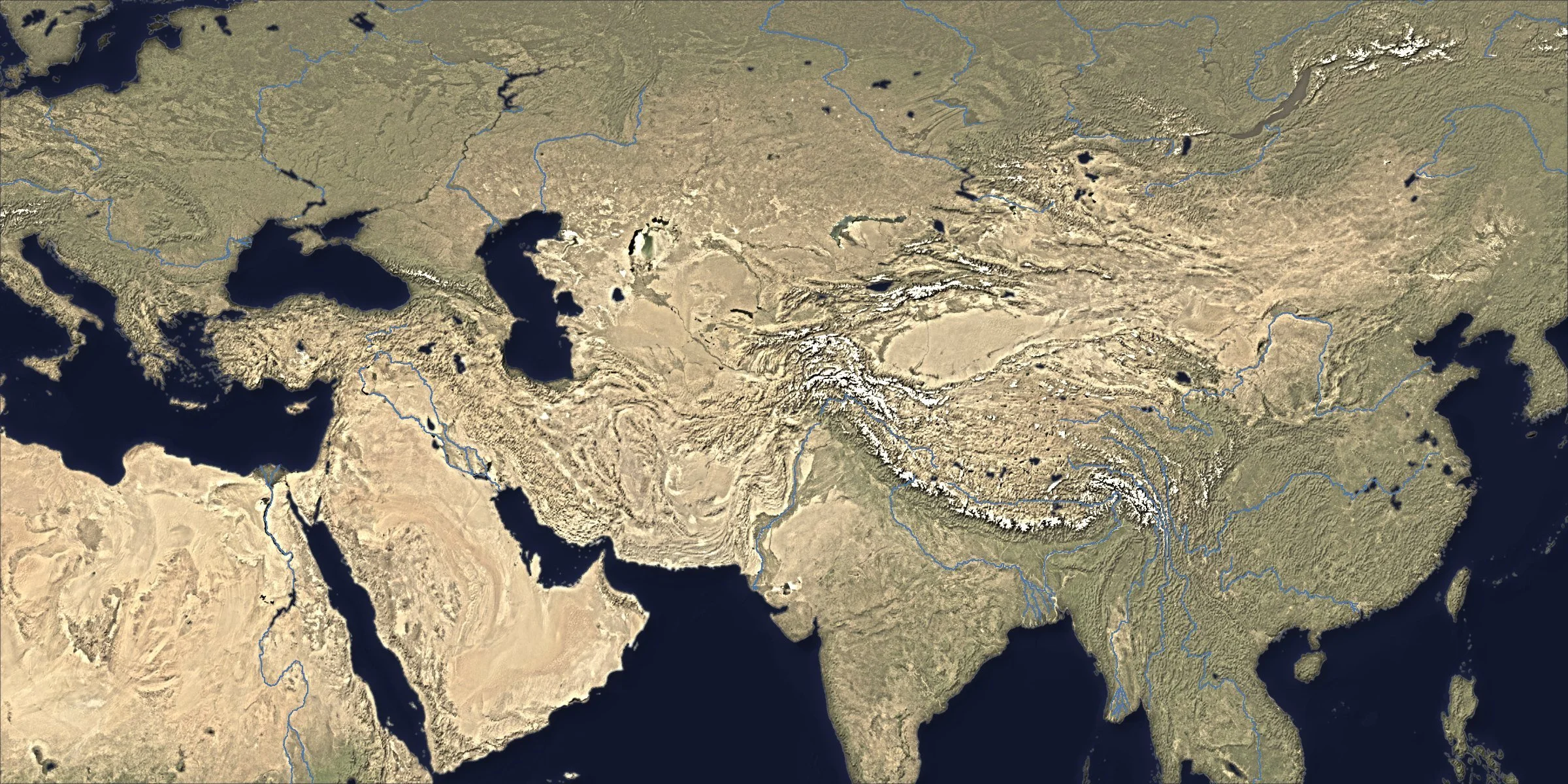
Swipe the map to explore.
Map: Eurasia and the Silk Road. Relief from NASA Blue Marble and Natural Earth (public domain). Ancient borders and regions are approximate.
More Than Silk Traveled the Silk Road
The route earned its name from one valuable good, but what moved along it reshaped religion, science, and daily life across three continents.
The Silk Road was not a single road, but a shifting network of overland and maritime trade routes connecting Han China to the Mediterranean world, passing through Central Asia, Persia, and India along the way. It took its name, coined centuries later by a European geographer, from Chinese silk, one of its most valuable and sought-after goods, but silk was only one item among many that moved along these routes for well over a thousand years.
Merchants carried spices, precious stones, glass, paper, and countless other goods across the network, rarely traveling the entire distance themselves. Instead, goods typically passed through a relay of regional traders, each covering one stretch of the route, meaning an object could travel thousands of miles without any single merchant ever seeing both its start and end points. This system connected civilizations that never had, and likely never would have, direct contact otherwise.
Goods were far from the only thing exchanged. Buddhism spread from India into China largely along Silk Road routes, carried by monks and merchants alike. Papermaking technology, developed in Han China, eventually traveled west and reshaped record-keeping and scholarship across the Islamic world and, later, Europe. Religious ideas, artistic styles, agricultural techniques, and even diseases moved along the same routes as silk and spices, making the Silk Road one of history's clearest examples of how thoroughly interconnected the classical world truly was, long before any of these civilizations knew much about one another directly.
The Silk Road began with an explorer. Around 138 BCE, the Han emperor Wu sent an official named Zhang Qian west into Central Asia, and Zhang Qian's reports of rich kingdoms and fine horses inspired the emperor to establish trade connections. Once Han leaders achieved peace to the north and west, China became more connected to other cultures, and the Silk Road increased the Han dynasty's wealth. Its main purpose was to promote trade. Merchants organized caravans of camels to move silk and other goods through deserts and mountains, and Central Asian nomads played an important role as guides, traders, and protectors. China exported silk and, in later centuries, tea and spices, and it imported goods such as glass and horses, while gold mainly traveled from west to east as Rome paid for Chinese silk. People gained wealth from trade, and distant areas became dependent on one another for certain goods, which is why historians consider the Silk Road an early step in globalization.
Buddhism reached China during the Han dynasty, carried over the Silk Road by missionaries and merchants. According to tradition, the Han emperor Ming saw the Buddha in a dream and sent messengers to learn about the faith. At first, Buddhism spread slowly because it had developed in a foreign land, but translating sacred texts into Chinese helped. When conflict tore apart the end of the Han dynasty and invasions caused hardship, many people questioned Confucianism and found comfort in Buddhist teachings about ending suffering. By the Tang dynasty, Buddhism had become the most popular religion throughout China, and its ideas later influenced Neo-Confucianism during the Song dynasty. From China, Buddhism spread to Korea and then to Japan.
Adapted from Studio Aletheia's World Builders Academy curriculum library, drawing on classical world history resources on Silk Road trade networks.
Materials for the evidence lab.
- A. Evidence Cards, provided
- B. Highlighters, 2 colors minimum
- C. Chart paper or notebook paper
- D. A pencil for mapping
- E. Your Evidence Log
Every session: identify the evidence, cite where it came from, connect it to the day's vocabulary, write a one-paragraph explanation.
Trace the Cargo
Practice identifying what traveled the Silk Road and what effect it had on the civilization that received it.
Map the Network
Before your unit synthesis in the final lesson, connect all four classical civilizations on one map.
Evidence Log
Accountability Checklist
Exit Challenge
Explain why the Silk Road matters to a unit about classical civilizations, even though it was not a civilization itself.
Updated: —
- —
| Item | Type | Qty | Cost | Status | Fulfilled |
|---|---|---|---|---|---|
| No purchases yet. | |||||