 Studio Aletheia · World Builders Academy
6.1.CXSC 6th Grade World Civilizations
Rome That Never Fell
Lesson 2.16 · The Byzantine Empire and Justinian I
While the western half of the Roman Empire collapses, its eastern half survives, and thrives, for another thousand years under a different name. Today you meet the emperor who tried to reunite Rome, and the faith his empire carried into the modern world.

Learning Targets and Success Criteria
Build the vocabulary and evidence needed to meet standard 6.1.CX.
What I will learn
- I can explain how the Byzantine Empire continued after the fall of the western Roman Empire.
- I can describe Emperor Justinian I's major achievements.
- I can explain the origins of Orthodox Christianity and its connection to the Byzantine Empire.
- I can connect Byzantine history to Orthodox Christianity's continued practice today.
What success looks like
- I explain how the Byzantine Empire differed from and continued Roman traditions.
- I describe at least one achievement of Justinian I.
- I explain the connection between the Byzantine Empire and Orthodox Christianity.
- My exit ticket connects Byzantine history to a contemporary example.
Contextualize the origins and spread of major world religions and their enduring influence.
Earn up to 25 XP in this lesson.
Skill Points and Challenge Points count toward your XP, and you can spend them in the Vending Machine and Monorail Mercantile.
Skill Points
- Answer the Check for Understanding in “One Empire, Two Fates.”
- Complete all four responses in “Continuity or Change?”
- Record your Evidence Log entry in “Trace the Split.”
Challenge Points
- Check off all four items on the Accountability Checklist.
- Answer the Exit Challenge with specific evidence from today’s lesson.
- Use at least two vocabulary words correctly (for example, Byzantine Empire and Justinian I).
Points are awarded by your teacher after the lesson. Partial work earns partial points, and make-up work earns full points when it’s turned in.
An empire that outlived the city it was named for.
These terms will be used throughout the mini-lesson, evidence lab, hands-on activity, journal, and exit challenge.
Byzantine Empire
The eastern continuation of the Roman Empire, centered on Constantinople, which survived for nearly a thousand years after the western Roman Empire fell in 476 CE.
Justinian I
A Byzantine emperor (527 to 565 CE) known for codifying Roman law, building the Hagia Sophia, and attempting to reconquer former western Roman territory.
Justinian Code
A massive collection and reorganization of Roman law compiled under Emperor Justinian I, which became a foundation for legal systems across Europe centuries later.
Orthodox Christianity
A major branch of Christianity centered historically on the Byzantine Empire and Constantinople, which developed distinct traditions from the Christianity centered on Rome.
Where this shows up in the real world.
History is not just something that happened. It is training for how you will read evidence, weigh sources, and make decisions in a career.
Reorganizing a Thousand Years of Law
Justinian's legal scholars faced a challenge legal historians still admire: organizing centuries of scattered, sometimes contradictory Roman law into one usable, coherent code.
Engineering a Dome That Still Stands
The Hagia Sophia's massive dome, built under Justinian, pushed sixth-century engineering to its limits and still influences architects studying how to build large open spaces without modern materials.
The Byzantine Empire, Rome that never fell.
After the western empire fell in 476, the eastern half survived for a thousand years, ruled from Constantinople. Justinian briefly won back Italy and North Africa.
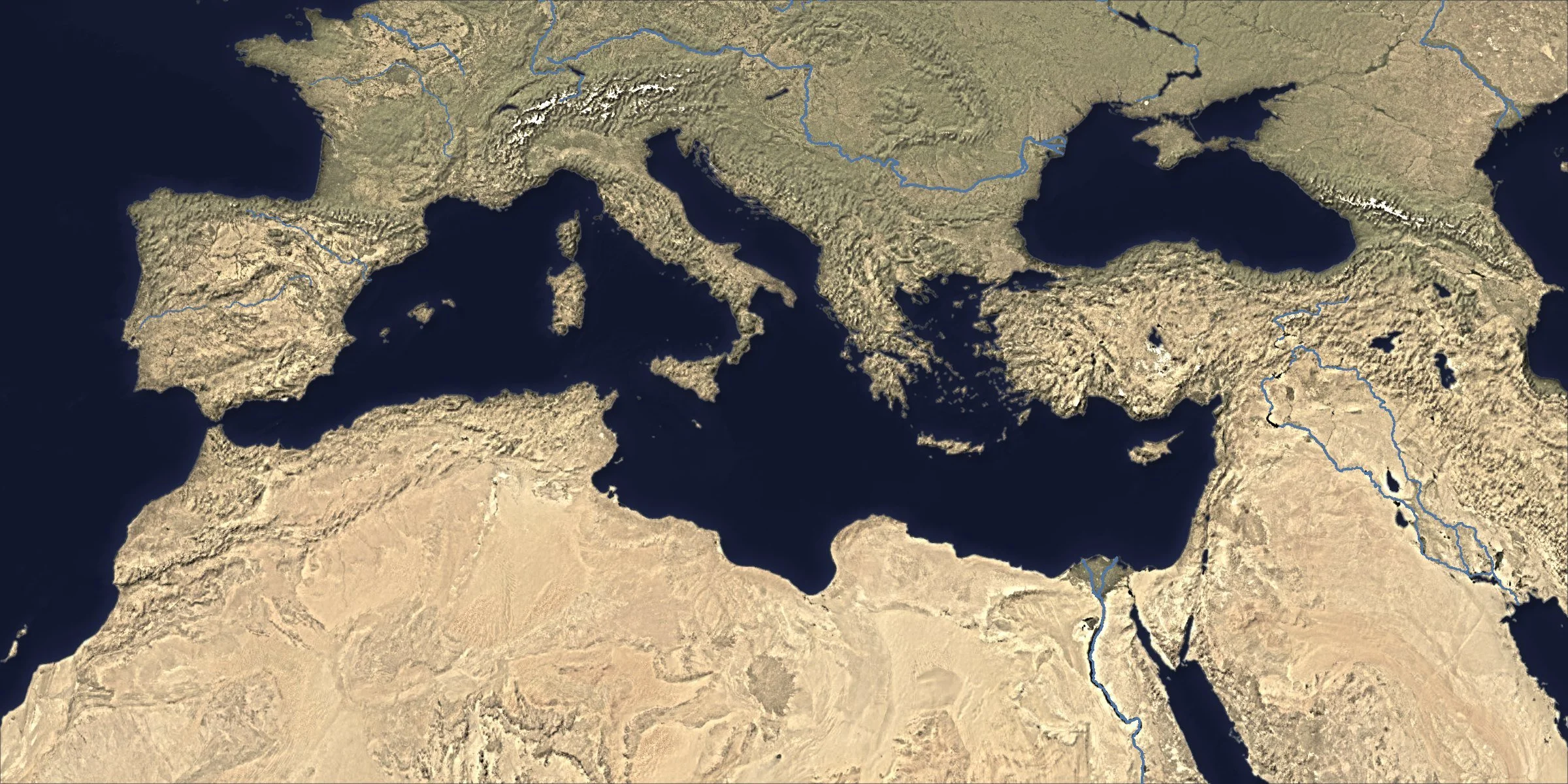
Swipe the map to explore.
Map: Mediterranean World. Relief from NASA Blue Marble and Natural Earth (public domain). Ancient borders and regions are approximate.
One Empire, Two Fates
When the Roman Empire split into western and eastern halves, only one of them collapsed in the fifth century.
By the late fourth century CE, the Roman Empire had effectively split into western and eastern halves, each with its own emperor. The western half, weakened by economic decline, internal conflict, and repeated invasions, finally collapsed in 476 CE when its last emperor was deposed. The eastern half, centered on the city of Constantinople (modern Istanbul), survived, continuing many Roman traditions, laws, and institutions for nearly another thousand years. Historians call this surviving state the Byzantine Empire, though its own people continued to call themselves Romans.
The Byzantine Empire reached one of its high points under Emperor Justinian I, who ruled from 527 to 565 CE. Justinian ordered a massive legal project: the collection, reorganization, and clarification of centuries of scattered Roman law into a single, coherent legal code, later known as the Justinian Code. This code preserved Roman legal tradition through the centuries and became a foundation legal scholars in medieval and later Europe would return to again and again. Justinian also oversaw ambitious building projects, most famously the Hagia Sophia, an enormous domed cathedral in Constantinople that pushed the engineering limits of its time, and he launched military campaigns attempting to reconquer former western Roman territory in Italy and North Africa.
Religion also shaped the Byzantine Empire's identity and legacy. As Christianity developed over the centuries following Constantine's legalization of the faith, differences in language, tradition, and authority gradually separated the Christian communities centered on Rome from those centered on Constantinople. This divide deepened over centuries and formally split in 1054 CE into what became known as Roman Catholicism in the west and Orthodox Christianity in the east. Orthodox Christianity, shaped by Byzantine tradition, remains one of Christianity's major branches today, practiced widely across Eastern Europe, Russia, Greece, and beyond.
Justinian's Code belongs to a long tradition you have traced since Unit 1. Hammurabi's Code in Babylon, Draco's Code in Athens, and Justinian's Code in the Byzantine Empire each took laws out of the memories of a few powerful people and wrote them down. Codifying laws benefited all three societies in the same ways: one written set of laws applied across a large territory, punishments became predictable instead of depending on a ruler's mood, private revenge gave way to public justice, and people gained a shared standard for settling disputes. Written law brought both order and unity.
Adapted from Studio Aletheia's World Builders Academy curriculum library, drawing on classical world history resources on the Byzantine Empire.
Materials for the evidence lab.
- A. Evidence Cards, provided
- B. Highlighters, 2 colors minimum
- C. Chart paper or notebook paper
- D. A pencil for mapping
- E. Your Evidence Log
Every session: identify the evidence, cite where it came from, connect it to the day's vocabulary, write a one-paragraph explanation.
Continuity or Change?
Practice sorting evidence about the Byzantine Empire into what it continued from Rome and what it changed.
Trace the Split
Map how one empire and one faith gradually divided into two traditions still recognizable today.
Evidence Log
Accountability Checklist
Exit Challenge
Explain one way the Byzantine Empire's legacy, law, architecture, or religion, is still visible in the world today.
Updated: —
- —
| Item | Type | Qty | Cost | Status | Fulfilled |
|---|---|---|---|---|---|
| No purchases yet. | |||||