

Studio Aletheia · Character & Storyline Reference Guide · v1.1
The Campus
AstroNautical &
Team Awesome Awesome Team
A narrative learning platform set on the Studio Aletheia campus - ten characters, five learning centers, one year-long arc of parallel discovery. The learner travels alongside the characters, not above them.
01 — The World
Studio Aletheia Campus
Studio Aletheia is a radial campus built around a central hub of the same name. Five spoke-paths extend outward to five specialized learning centers, each dedicated to a distinct discipline. The campus is connected by elevated monorail, waterway, and pedestrian paths — every building is visible from the center, ensuring that no discipline ever feels entirely separate from the others.
The world is set in an optimistic near-future: clean energy, green architecture, and technology that serves learning rather than replacing it. The characters live and work here, moving between centers as their projects demand. The learner moves with them.
Campus Layout — Hub & Five Centers

The Five Learning Centers

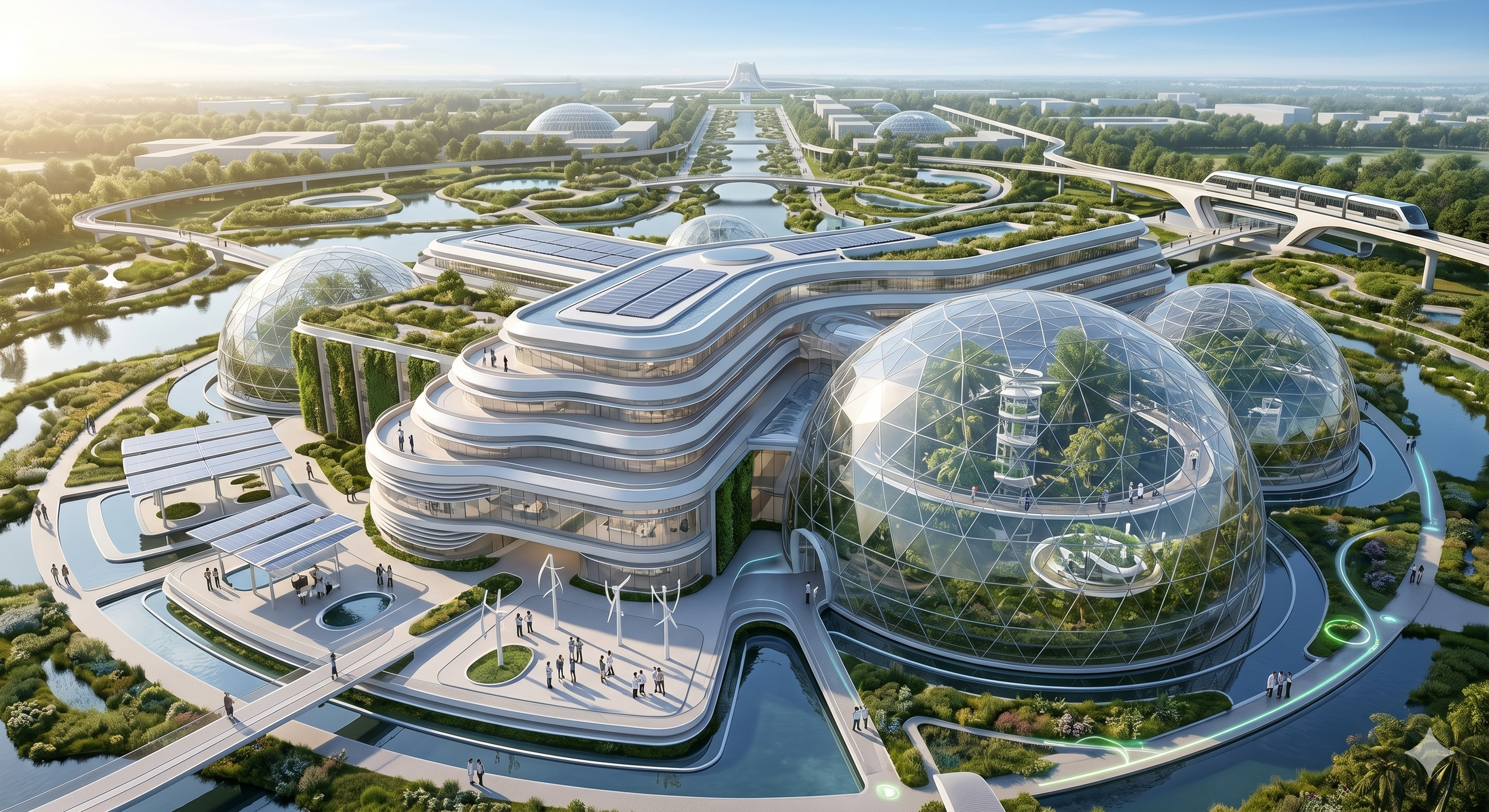


All five centers connect to Studio Aletheia via elevated monorail and pedestrian spokes. Cross-center tasks require characters to travel between buildings.
02 — The Learning Centers
Five Centers, One Campus
Each center is a full discipline environment — not just a classroom but a working studio, lab, trading floor, or archive. Characters have home centers where they excel but are constantly required to visit other centers for cross-curricular work.
The oldest building on campus — its archives hold primary sources from every civilization studied. Students here learn to think like historians: reading evidence, constructing timelines, and arguing from sources. The building also houses the cartography studio and the oral history recording booth.
Skills housed here
Part laboratory, part engineering studio, part field station. The center is built into a living wall of plant systems and solar collectors — the building itself is an experiment. Students here investigate, design, test, and revise. The rooftop weather station and the basement geology core collection are its most iconic spaces.
Skills housed here
Clean, precise, and filled with light. The center has a data visualization wall that displays live feeds from every other building on campus — making the mathematical patterns in the world visible in real time. Students work here on everything from number sense to statistical analysis, often in service of projects anchored elsewhere.
Skills housed here
The most stylistically distinctive building on campus — part library, part editorial studio, part performance space. Characters come here to write, research, argue, present, and revise. La Maison has a podcast booth, a debate floor, and a rare books archive. Every major project eventually passes through its doors for its communication layer.
Skills housed here
The newest and most dynamic building on campus — the trading floor hums with activity, and the investment portfolio boards update in real time. Students here learn to make decisions under uncertainty, evaluate risk, read data, and communicate financial ideas to stakeholders. The work here almost always requires skills from other centers: math for modeling, writing for proposals, science for sustainable investment, and history for context.
Skills housed here
03 — The Characters · AstroNautical
Team AstroNautical

Alexander sees the big picture that others miss. He is drawn to patterns in history — how civilizations rise, collide, and collapse — and he has a gift for helping his team understand why events happened, not just that they did. His natural authority comes not from demanding attention but from always having done the reading.
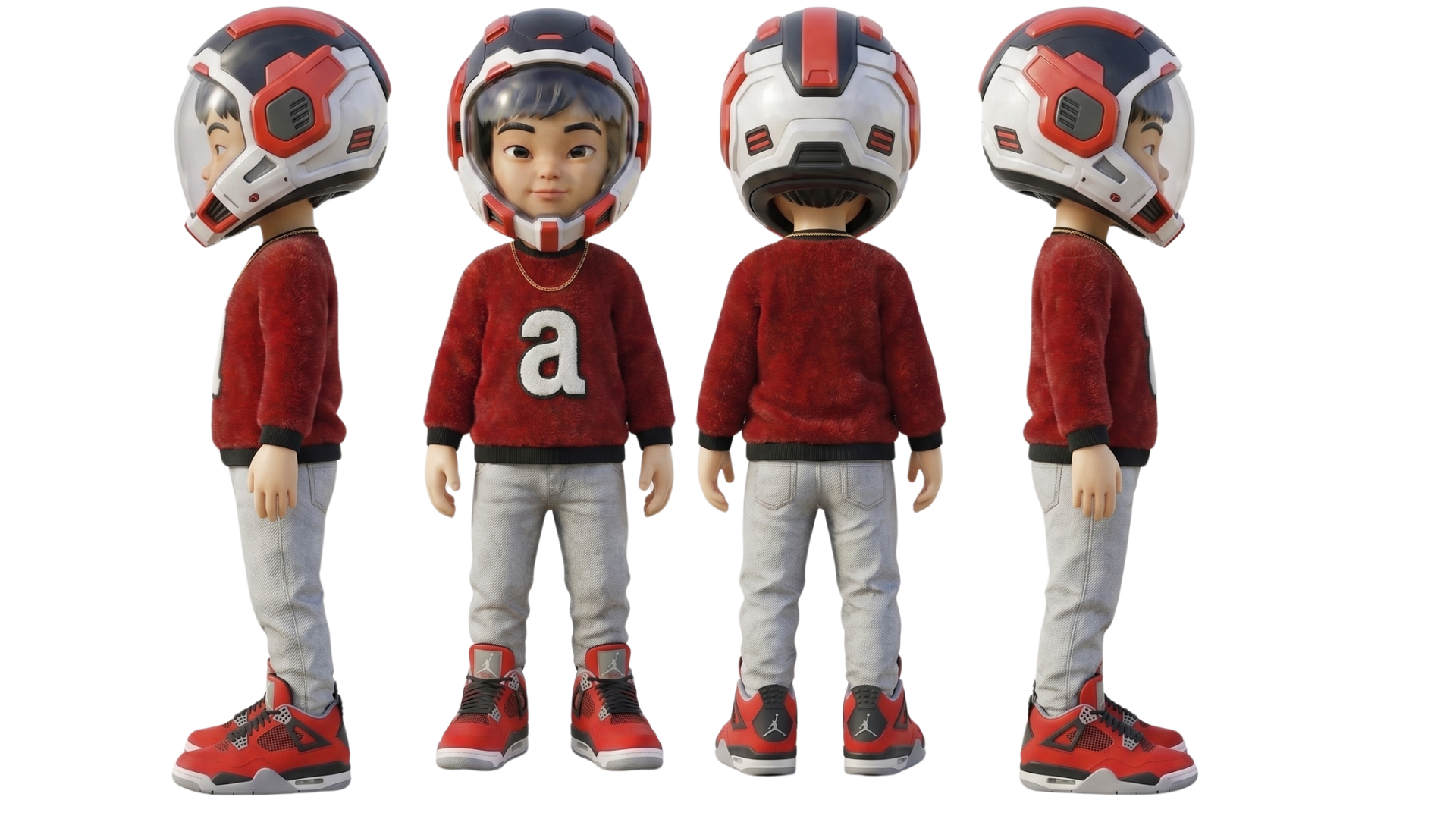
Anthony thinks in numbers and opportunity costs. He is the first person on either team to spot when a project doesn't pencil out, and the first to propose a creative financial solution. He loves the trading floor but struggles when he has to explain his thinking in writing — which brings him regularly to La Maison Lexicon.

Amari is the most methodical thinker on either team. He approaches every problem as an investigation — hypothesis first, evidence second, conclusion only when the data supports it. He is most at home in The Center for Applied & Sustainable Sciences but has a growing appreciation for the way history provides natural experiments in human behavior.

Arlo sees the world spatially. He naturally thinks in shapes, structures, and visual proofs. While Angie (across the campus on Team TAAT) can generalize patterns algebraically, Arlo is the one who sees why the geometry is true — and can usually build a physical model to prove it. He struggles with writing arguments and often enlists Apollo's help.

Apollo is the communicator of AstroNautical. He turns his team's thinking into writing that actually reaches people — investment proposals, research reports, historical arguments, oral presentations. He is the most collaborative character on either team because his skill is inherently cross-disciplinary: every good piece of writing starts with knowledge that came from somewhere else.
04 — The Characters · Team Awesome Awesome Team
Team Awesome Awesome Team

Aletheia is named for the Greek concept of truth as "unconcealment" — and she lives that name. She is drawn to the questions other people avoid: whose story isn't being told, whose perspective was left out of the record, who paid the cost of someone else's progress. She and Alexander share a home center but ask completely different questions when they arrive.
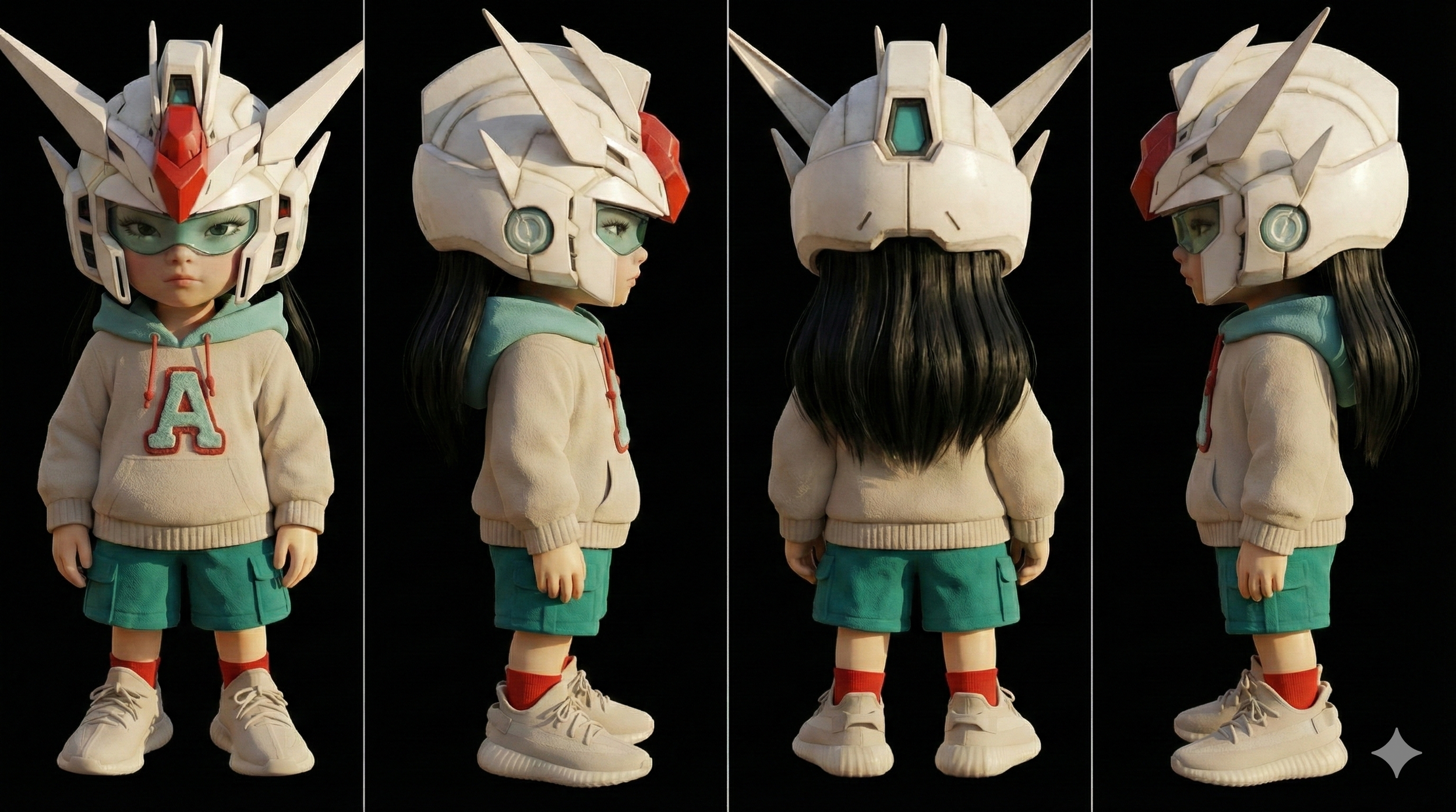
Amy thinks visually before she thinks verbally. She is the team's designer, illustrator, and visual communicator — and she brings those skills to La Maison Lexicon in ways that consistently surprise the writing-focused characters there. Her multimedia projects are the most memorable on either team, but she needs help with the analytical writing that often accompanies them.
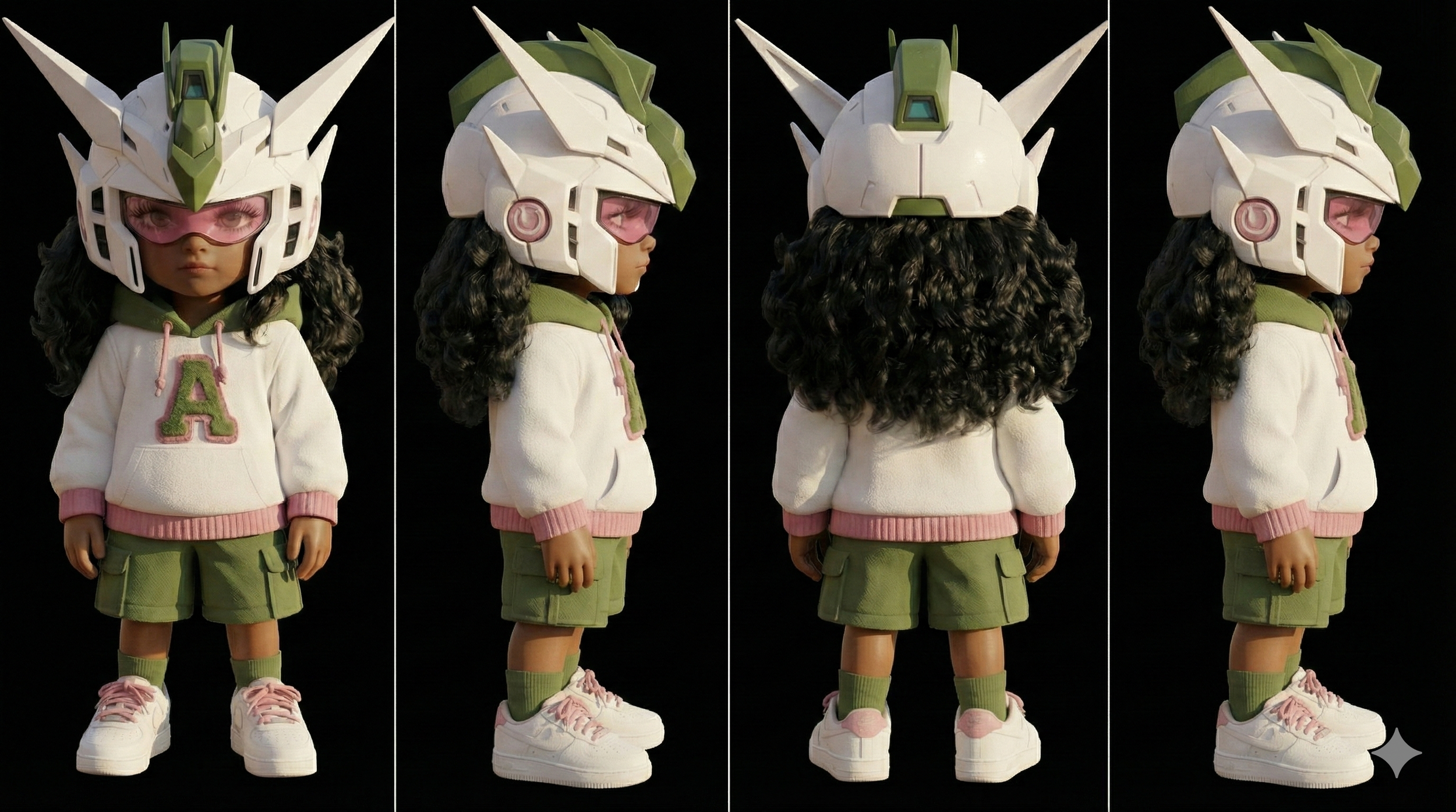
Angie sees patterns as rules. Where Arlo builds models, Angie writes equations. She can look at a table of values and immediately sense the underlying function — and she has a gift for explaining algebraic ideas to other characters who have been staring at numbers without seeing the pattern. She visits The Center for Applied & Sustainable Sciences often because data always has a pattern hiding in it.
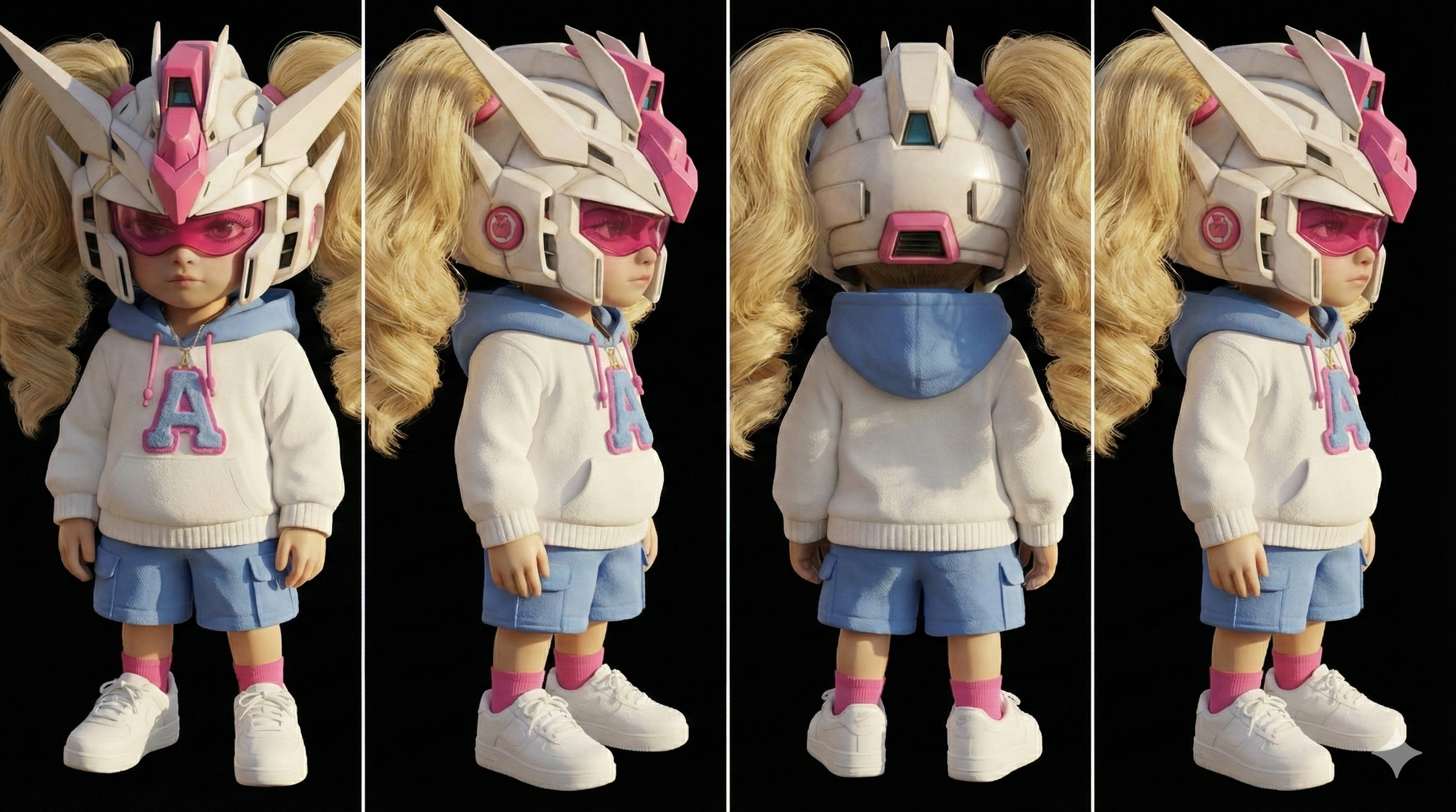
Allison hears structure in everything. She is the team's most unexpected mathematician — because music is mathematics in time — and she brings that rhythmic, pattern-sensitive mind to every discipline she touches. She excels at oral presentation and storytelling, and her science lab reports are often the most elegantly structured on either team.
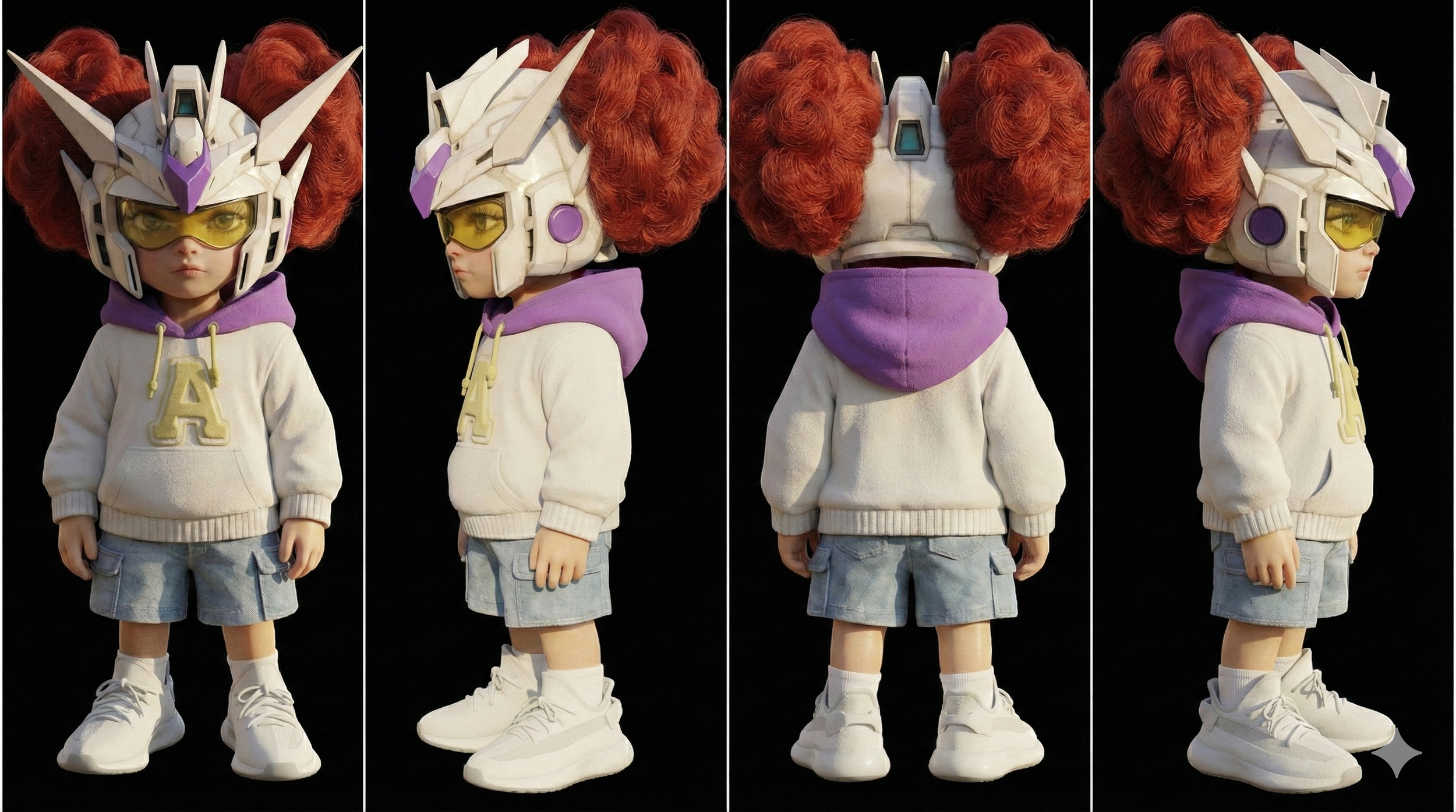
April is drawn to the physical world — how it formed, how it moves, how human activity has changed it. She is the team's environmentalist and systems thinker, equally comfortable at The Center for Applied & Sustainable Sciences and the World Builders Academy cartography studio. She often serves as the bridge between the two teams because her work at the intersection of environment and history is essential to the campus's biggest cross-curricular projects.
05 — The Learner
Your Role in the World
The learner is not a passive viewer, a mascot controller, or an external observer. They arrive at Studio Aletheia at the same time the characters do — with their own incomplete skill set and their own path to build across the campus. The characters are companions on a shared journey, not dependents waiting for direction.
When Amari is working through how to model his data algebraically, the learner is working through the same challenge at the same table. When Anthony is struggling with his investment proposal, the learner is sitting with Apollo in La Maison Lexicon figuring it out together. The characters reflect where the learner is. If the learner hasn't yet worked through geometric reasoning, Arlo is still in the middle of his. When the learner masters it, Arlo moves forward too.
This means the learner has their own progress track — their own map of unlocked centers, their own XP balance across SP, CP, and RP, and their own growing network of cross-curricular connections. They travel alongside the characters. The campus was built for exactly this kind of journey.
06 — The Mission Loop
How Every Mission Works
Every mission at Studio Aletheia follows the same repeating cycle. The story context changes — the characters, the center, the challenge — but the structure is always predictable. Learners know what to expect at every step, which means their cognitive load stays focused on the content rather than the interface.
Arrive at a learning center. The environment, characters present, and active challenges come into view.
A character presents a real problem they can't solve alone. The learner understands what's needed and why it matters.
The learner builds or deepens the specific skill required — through instruction, examples, and guided practice alongside the character.
The learner applies the skill to complete a structured task. Accuracy, depth, and effort each contribute to the outcome.
SP, CP, and RP are awarded based on performance. Both the learner's track and the character's track advance simultaneously.
The completed task illuminates a node on the campus map. New paths, characters, and challenges become available.
The learner produces something: a written piece, a data model, a visual, a lab report. Artifacts accumulate into a portfolio across the year.
A brief metacognitive prompt asks what the learner understands now that they didn't before. Honest reflection earns RP.
A cross-curricular bridge appears — a character or task from another center that the current work makes newly accessible.
07 — How a Week Works
The Platform in a Classroom Week
Studio Aletheia is designed to map cleanly onto a standard instructional week. Each day has a distinct campus location, purpose, and student action. Teachers, administrators, and curriculum partners can use this structure to understand what the platform looks like in practice during normal instruction.
08 — Narrative Arc
Three Major Projects, One Year
The academic year is structured around three anchor projects — Beginning of Year, Middle of Year, and End of Year. Each project requires all five learning centers and both teams to collaborate. Between them, a series of smaller center-specific and cross-curricular tasks keeps the narrative moving and skills building.
Project Rhythm Note — The three major projects are not isolated one-week assignments. They are layered, long-range synthesis arcs that launch at different points, remain active across multiple weeks, and culminate at different stages of the school year. Their day ranges intentionally overlap. A learner working on The Exchange Report mid-year may still be finalizing an element of The Origin Dispatch — and early work on The Future Proposal begins before The Exchange Report closes. This overlap is by design.
The Origin Dispatch introduces the campus, the characters, and foundational disciplinary thinking across all five centers. The Exchange Report deepens cross-center and cross-team collaboration by demanding skills no single character — or single discipline — can supply alone. The Future Proposal is the culminating interdisciplinary synthesis, the project that can only exist because all the prior work happened.
Both teams arrive at Studio Aletheia as strangers. Their first major assignment: produce a collaborative dispatch from the beginning of human civilization — a multi-format document including a historical narrative (World Builders Academy), a scientific explanation of Earth systems (The Center for Applied & Sustainable Sciences), a data analysis of population and geographic patterns (The Center for Quantitative Studies), a written primary source analysis (La Maison Lexicon), and a trade economy model for one early civilization (The Aletheian Investments & Trading Institute). Every character contributes their partial skill. The learner works through the same tasks in parallel — progress and growth advance together.
The campus receives a distress signal from its simulation of the medieval global trade network — something has gone wrong, and the teams must diagnose and document it. This project centers on the Q2–Q3 integration: trade routes and climate systems, the Scientific Revolution's impact on knowledge and power, and the ethical contradictions of progress. The Exchange Report is a full multimedia presentation requiring research, data, writing, scientific modeling, and a financial analysis of who gained and who lost. No single team has all the skills it demands — cross-team collaboration is required to complete it.
The year-end project is the most ambitious: using everything learned across all four quarters, both teams jointly design a proposal for a sustainable future system — a city, an economy, an institution, or an ecosystem restoration project. The proposal must include a historical argument for why this intervention is needed (World Builders Academy), a scientific feasibility analysis (The Center for Applied & Sustainable Sciences), a full financial model (The Aletheian Investments & Trading Institute), a mathematical projection of outcomes over time (The Center for Quantitative Studies), and a polished presentation document (La Maison Lexicon). The proposal is as ambitious as the year-long journey that produced it.
09 — Cross-Curricular Collaborations
How the Tasks Connect
These examples show the smaller cross-curricular collaboration tasks that appear between the three major projects. Each requires at least two characters from potentially both teams. The learner participates in each task alongside them — earning XP on their own track while the characters advance on theirs.
Anthony has identified a strong investment opportunity but can't get it funded without a written proposal. The learner works through the investment analysis at The Aletheian Investments & Trading Institute alongside Anthony — both advancing their financial reasoning in parallel. Then the learner travels with Anthony to La Maison Lexicon, where they work through the technical writing task alongside Apollo. Both the learner and the characters earn XP at each stop, and the collaboration unlocks a bonus node that neither could reach alone.
The teams receive a topographic map of a river valley. April describes what geoscience processes formed it. Amari designs the investigation to test their hypothesis. Alexander contextualizes what civilizations it could have supported. The learner works through all three tasks alongside them — moving between The Center for Applied & Sustainable Sciences and World Builders Academy just as the characters do, building their own cross-curricular connection between the two centers. The cross-team collaboration unlocks a bonus node on every participant's map.
Arlo can show why a geometric pattern is true. Angie can write the equation that generalizes it. Neither can do the other's job. The learner visits both at The Center for Quantitative Studies — working through Arlo's geometric proof task and then Angie's algebraic generalization task in sequence. All three tracks — Arlo's, Angie's, and the learner's — advance in parallel. The full Functions concept node unlocks on every participant's map once both tasks are complete.
10 — Progress System
How the Learner Advances
Progress through the campus is earned, not given — by the learner and the characters simultaneously. Each task completed earns XP on both the learner's track and the character's track in that center. The campus map always displays both at the same time: the learner can see exactly where they stand relative to the characters, and where the characters stand relative to each other.
The learner progresses by helping characters move from partial skill to stronger mastery — and by growing their own skills in parallel. Neither track advances without the other. The map makes that relationship visible at all times.
Earned for accuracy and precision. These come from tasks with correct/incorrect answers — calculations, source analyses, scientific data interpretation. SP reflects content mastery.
Earned for synthesis, depth, and creative application. These come from writing tasks, design challenges, and cross-curricular projects where quality of thinking matters more than a single answer.
Earned for metacognitive work — self-assessment, explaining what went wrong, articulating what changed in how you think. RP tracks the learner's awareness of their own growth.
The campus map shows two parallel progress tracks at all times — the learner's own unlocked nodes and the characters' current positions. When the learner works through a writing task alongside Apollo at La Maison Lexicon, both tracks illuminate simultaneously. The map makes the relationship between learner growth and character growth visible in real time.
Skill or center not yet available. Prerequisite task not completed.
Current mission or project step. Character is present and the learner can engage now.
Task mastered or artifact submitted. XP awarded. Node permanently illuminated.
Interdisciplinary collaboration between two centers. A visible connection line links both buildings on the map.
Beginning, Middle, or End-of-Year synthesis milestone. Unlocks the next arc of the narrative.
Shows where each character currently is on the map — active, waiting, or ready to advance.
Shows where the actual student is on the map in relation to the characters — their personal progress overlay.
Requires characters from both AstroNautical and Team Awesome Awesome Team. Bonus XP available for all participants.